Showing posts with label silhouette animation. Show all posts

20 May 2017

Urashima Tarō (浦島太郎, 1918)


Urashima Tarō (浦島太郎, 1918)
dir. Seitarō KITAYAMA (北山清太郎)

Seitarō Kitayama’s 1918 short animation Urashima Tarō (浦島太郎, 1918) was considered lost for over 60 years until it was rediscovered along with Jun’ichi Kōuchi’s The Dull Sword (なまくら刀 / Namakura Gatana, 1917) in an Osaka antique shop in 2008 by visual culture historian Natsuki Matsumoto (source).  It is the only extant work of at least 8 animated shorts that were made in Japan in 1918.  The film was digitally restored from Matsumoto’s 35mm tinted silver nitrate positive copy and was screened at the NFC in 2008 as part of a programme called Cinema Lost and Found 2008 (発掘された映画たち2008) .  It  and can now be viewed online in the NFC’s Animation Film Archives as part of their celebration of the centenary of animation production in Japan.

The animation is an adaption of the well known folk tale of the same name.  The earliest known record of the name Urashima Tarō is in an otogizōshi (御伽草), a kind of illustrated prose narrative, from the Muromachi era (c. 15th century).  However, the story itself dates back even further to the Nara period, where it appears in such works as the Nihon Shoki (The Chronicles of Japan) and the Man’yōshū (Collection of Ten Thousand Leaves) under the name Urashimako.  

It is a kind of a Rip Van Winkle tale but instead of falling asleep, the main protagonist goes out to sea on the back of a turtle.   After many adventures (there are many variations of the tale), he returns home to find that hundreds of years have past.   In Japanese culture, Urashima Tarō is a short hand expression for that feeling one has returning home after a long absence and feeling out of place. 

It was clever of Kitayama to choose a familiar story, because with such a short animation (under 2 minutes running time) he did not have a lot of time to waste on exposition.  The short begins with Urashima Tarō with his back to the camera walking to the sea with a fishing rod slung over his shoulder.  In the next shot, he paddles his boat from bottom screen right to top screen left.  The next shot using an iris matte to focus on Urashima Tarō fishing peacefully in his boat.  This is followed of an extreme long shot of Urashima Tarō struggling in his boat, in now choppy waters, with menacing figures of large fish under the water.


He falls to the sea floor, where is appears to cry until he is rescued by a large turtle who tells him to climb onto his shell.  The sequence of Urashima Tarō travelling on the turtle’s back is shot using silhouette animation.  He appears to arrive at a palace where he is escorted by humanoid figures with fish heads.  Cut to a princess standing in the window who appears to beckon in a friendly manner.  Iris in.  Iris out to outside of the palace.  A large bubble exits the palace door and floats upwards.  Urashima Tarō bursts from the bubble back onto the shore.  His costume is the same but he is now an elderly man.  He appears to laugh.  End title cards.

Without the benefit of the benshi narrator, who would have accompanied the film when it was first screened, the nuances of the story have been lost.  The facial expressions, gestures, and use of the absurd (fish headed people) suggest the film was meant to be humorous.  The choice of red tinting (the NFC describes it as “pink”) is unusual because red was usually used in silent films to indicate scenes of fire or immense passion.  Logically one would expect the underwater sequences to have been tinted in blue and the island sequences in yellow to indicate sunlight.  Perhaps light red was the only tint available to Kitayama at the time – although Jun’ichi Kōuchi did use a blue/green tint and a yellow tint for The Dull Sword (1917).  I will update if I find any information about the use of tinting in Japan during this period.

Although the film is very short, Kitayama manages to demonstrate a number of techniques including cutouts, silhouette animation, irises, and the use of three layers of space.  As we only have two extant films from the many made during 1917 and 1918, this film is an important glimpse into the abilities of Kitayama and his fellow animators at this time.

I am not sure what name is indicated by the initials Y.N. in the end credit.  The NFC lists the production company as Nikkatsu Mukojima Studio (日活向島), for whom he worked until he established his own studio Kitayama Eiga Seisakusho (北山映画製作所) in 1921.  The studio was unfortunately destroyed by the Great Kantō Earthquake in 1923 leading Kitayama to give up animation and move to Osaka where he worked as a newsreel cameraman (Learn more).

2017 Cathy Munroe Hotes

13 March 2017

The Dull Sword (なまくら刀, 1917)


Japan is celebrating the centenary of anime this year. Due to the paucity of early cinema records in Japan there is much debate as to when exactly animation was first publicly screened in the country. However, we do know that the 1910s saw screenings of foreign works by Émile Cohl, James Stuart Blackton, James Randolph Bray, and Raoul Barré. There is also evidence that many people were experimenting with the animation medium before 1917, but it was the year that the first studio was organised to make animation for public screenings. 

The cartoonists Ōten Shimokawa (下川凹天, 1892-1973), Seitarō Kitayama (北山清太郎, 1888-1945), and Jun’ichi Kōuchi (幸内純一, 1886-1970) produced at least 20 short animated films in 1917. The earliest of these is generally thought to have been Shimokawa’s The Story of the Concierge Mukuzo Imokawa (芋川椋三玄関番之巻, 1917), but there is evidence that there may have been an earlier work. You can read “Some remarks on the first Japanese animation films in 1917” by Frederick S. Litten to learn what is known about this time period. 

What is clear; however, is that almost all the Japanese animation films from the 1910s have been lost. Jun’ichi Kōuchi’s The Dull Sword (なまくら刀 / Namakura Gatana, 1917), also known as The Sword of Hanawa Hekonai (塙凹内名刀之巻 / Hanawa Hekonai meitō no maki), is the earliest known extant work. The Dull Sword and Kitayama’s Urashima Taro (1918) were miraculously discovered in an Osaka antique shop in 2008 (source). The film originally debuted on 30th of June 1917. 

Watch a news item on the discovery: 


A one-reel silent film, The Dull Sword was digitally restored and can be screened on the National Film Centre’s film archive website with subtitles by Dean Shimauchi. 

The film has a couple of title cards, but much of the apparent dialogue is un-titled. It is likely that these segments of dialogue were filled in by a benshi, or film narrator, as was standard practice in Japanese silent cinema. Watching the film completely silent on the NFC archive website, without the comic interpretation of a benshi, means that the full comic impact of the film is greatly reduced. One of the title cards is actually on its side (90° clockwise). The film was found with this splicing error and left as it was found by the restoration team.

The Dull Sword is a slapstick comedy, which was a popular genre of the silent period. It is likely Kōuchi and his early animation peers would have been familiar with imported comedies of the day such as the films of “the first international movie star” Max Linder of France, and American slapsticks such as those of Fatty Arbuckle, The Keystone Cops (1912-1917), and Charlie Chaplin. There are also elements of slapstick in many Japanese theatrical traditions such as manzai (漫才) and kyōgen (狂言). Add to the mix that Kōuchi was already an established mangaka and caricaturist when he made The Dull Sword, comedy would have come naturally to him. 


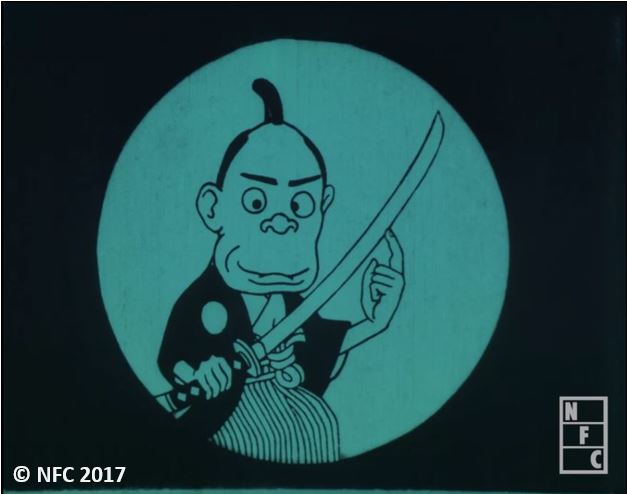
The opening title card, tinted yellow, immediately sets the scene as a jidaigeki with the profile of a samurai and a bent sword. The first section of the film is tinted a dark cyan. A samurai appears in an iris shot examining his sword and testing it for sharpness. His eyes roll comically and his sword overlaps the iris matte in a cinematic visual gag. He cuts his finger on the sword then takes it to the swordsmith “Dull Smith”. The dialogue between the swordsmith and the samurai does not have title cards, but it is clearly humorous in nature with much eye-rolling from both men. There is a slapstick routine of the samurai trying and failing to sheath his sword. Once the sword is finally sheathed, the samurai pays the swordsmith and leaves. 

In the next scene, the samurai is walking along the riverbank across from a large town. He gets out his sword and examines it. A title card reveals his desire to try out the sword. The film cuts to a bald, blind man with a cane playing a flute next to a tree. The samurai approaches him from behind. A yellow-tinted title card reveals that the samurai sees the blind man as a possible person to test his sword out on. He says something (presumably threatening judging from his facial expression) to the blind man. The blind man surprises the samurai by jumping up and kicking him in the face with his geta-clad feet. 

The remainder of the film is tinted yellow. The style is also different with silhouette figures instead of detailed caricatures. A traveller with his luggage on a stick carried over his shoulder is running through the forest and encounters the samurai. The samurai tries to attack him, but the traveller outwits him, hitting him on the head with his stick. The traveller runs away as the samurai struggles to raise his head. Via a speech bubble, the samurai accuses the traveller of being a murderer. The samurai tries to stagger off using his sword as a cane, but it breaks and he falls on his face. He throws the useless sword away. He exits frame left and the film concludes with a company logo reading Y.N. & Co. I am not sure what the Y.N. stands for as Kōuchi made the film for the short-lived company Kobayashi Shōkai (小林商会, 1914-17) run by Kisaburō Kobayashi (小林 喜三郎, 1880-1961) 

The film was transferred to digital format at 16 fps. There were many frames missing from the two film fragments (the cyan-tinted fragment and the yellow-tinted fragment) that had to be compensated for during the film restoration. The final restoration consists of a total of 3,180 frames. For such an early work, the animation is done quite well. Much of the cyan fragment has been hand drawn with cutouts used to save money and celluloid. I am not sure why the film switches to silhouette for the second half. The reason may be budgetary rather than stylistic. My own personal view is that such a short film would have been stronger if it had stuck to one style throughout. 


The most interesting thing about The Dull Sword is its use of a Japanese setting and subject matter. According to Jonathan Clements, the film received praise at the time for doing so (Anime: A History, p. 29). Before the discovery of these earliest works, we only had examples of anime from the 1920s-1940s which demonstrated the influence of popular American character design like Mickey Mouse, Popeye, Betty Boop, and Felix the Cat. This earliest extant anime has been drawn in a caricature style typical of the 1910s and the character design is such a contrast with today’s manga and anime styles. It is a wonderful glimpse into a film culture that we know so little about, due to the destruction wreaked by the Great Kantō earthquake if 1923, the firebombing of Tokyo, the flammability of early film stock, and the general neglect of early films after their initial screening runs. I hope one day to see this film interpreted by a benshi performance in order to get the complete cinematic experience. 
 Cathy Munroe Hotes 2017

24 August 2016

Hiroshima 2016 Focus on Japanese Animation: Day 1


Hiroshima 2016 Focus on Japanese Animation: Day 1

Hiroshima 2016 Focus on Japanese Animation: Day 1
Thursday, August 18
8月18 日(木)

As mentioned in 16th International Animation Festival Hiroshima 2016: Overview, the country focus at this year’s festival was Japan.  Since its founding, the motto of the Hiroshima festival has been “Love and Peace.”  The festival co-founders, the late Renzō Kinoshita and current festival director Sayoko Kinoshita, made a film about the bombing of Hiroshima called Pica-don (ピカドン, 1978) ) (read review) which is one of the greatest anti-war animations ever made.  Isao Takahata’s Grave of the Fireflies was made in the same spirit as Pica-don, which is why it is fitting that it should have opened the Japan Animation Special.  It was followed by two documentaries by anime pioneer Taiji Yabushita (薮下泰司, 1903-1986) about early Japanese animation history. Yabushita was the director of Tōei Animation’s first full colour feature anime The Tale of the White Serpent (1958), as well as their early features Magic Boy (1959) Alakazam the Great (1960), The Littlest Warrior (1960) and Arabian Nights Sinbad’s Adventures (1962).

Japanese Animation Special 1: Feature Animation
日本アニメーション大特集1:長編


Grave of the Fireflies
火垂るの墓
Isao Takahata / 高畑 勲
1988


Japanese Animation Special 2:
Japanese Animation History Part I and II by Taiji Yabushita
1. Manga Tanjo (Japanese Animation History Part I) / Taiji Yabushita / 1971
2. Anime Shingacho (Japanese Animation History Part II) / Taiji Yabushita / 1973

日本アニメーション大特集2:『漫画誕生』、『アニメ新画帖』藪下 泰司
1. 漫画誕生 藪下 泰司
2 . アニメ新画帖 藪下 泰司

Japanese Animation Special 3:History ①

This selection of films celebrates early animation pioneers in Japan.  It includes rare examples of the earliest commercial animation made in Japan – Jun’ichi Kōuchi’s Namakura Gatana (1917) and Seitarō Kitayama’s Urashima Tarō (1917).  Both films were considered lost until a researcher discovered copies in an antique shop in Osaka in 2008.  There is also an early work by Sanae Yamamoto, who later in life would help produce Toei Animation’s first feature anime, as well as works by Hidehiko Okuda, Tomu Uchida, Hakusan Kimura, Kiyoji Nishikura, and Ikuo Ōishi.  Yoshitsugu Tanaka’s Chimney-Sweeper Perrault (1930) is a rare example of an early silhouette animation film (kage animation).  Inspired by screenings of Lotte Reiniger’s works in Japan in the 1920s and Japan’s domestic traditions of kage-e and kage (shadow/silhouette) puppetry, Noburō Ōfuji became a master innovator of this technique in animation.  His work features heavily in this programme, including his 1952 film The Whale, which alongside his work The Phantom Ship (1956) brought his unique style of animation to the attention of European critics in the 1950s (Venice Biennale, Cannes, etc.).  He is considered Japan’s pioneering independent animator.  See: Noburō Ōfuji Award


For reviews of these films see:  Chameko’s Day, Whale

1.  A Blunt Sword (Namakura Gatana, 1917), Jun’ichi Kōuchi
2.  Urashima Tarō (1917), Seitarō Kitayama
3.  The Rabbit and the Turtle (1924), Sanae Yamamoto
4.  The Tale of Crab Temple (Kanimanji Engi, 1925) Hidehiko Okuda, Tomu Uchida, Hakusan Kimura
5.  Chimney-Sweeper Perrault (1930), Yoshitsugu Tanaka
6.  Noroma-na jiji, Noburō Ōfuji 
7.  A Ship of Oranges (Mikansen, 1927), Noburō Ōfuji 
8.  A Spider's Thread (1946), Noburō Ōfuji
9.  Whale (Kujira, 1952), Noburō Ōfuji
10.  Princess Kaguya (Taketori Monogatari, 1961), Noburō Ōfuji
11.  Chameko’s Day (1931, Kiyoji Nishikura
12.  A Fox and a Badger in Rivalry (1933), Ikuo Ōishi
13.  Ponsuke's Spring (1934), Ikuo Ōishi

日本アニメーション大特集3:歴史 ①
1. なまくら刀 幸内 純一 
2.  浦島太郎 北山 清太郎
3. 教育お伽漫画 兎と亀 山本 早苗 
4.  蟹満寺緑起 奥田 秀彦、内田 吐夢、木 村 白山 
5. 煙突屋ペロー 田中 喜次 
6.  のろまな爺 大藤 信郎 
7. みかん舩 大藤 信郎 
8.  蜘蛛の絲 大藤 信郎 
9. くじら 大藤 信郎 
10. 竹取 物語 大藤 信郎 
11. 茶目子の一日 西倉 喜代治
12. 動絵狐狸達引 大石 郁雄
13. ポン助の春 大石 郁雄

Japanese Animation Special 4:History ②

This selection features more works by early Japanese animation pioneers.  Yasuji Murata was mentored by Sanae Yamamoto in animation techniques and went on to become a master of cutout animation – a style used by most early animators in Japan because of the expense and lack of availability of celluloid for cel animation.  Murata is famous in particular for his use of popular Japanese characters such as folk hero Momotarō and popular manga figure Norakuro the dog.  Wagorō Arai was a dentist who dabbled in silhouette animation – read more about him here – inspired, like Noburō Ōfuji by seeing the works of Lotte Reiniger in the 1920s.  One of his most renowned works, Madame Butterfly's Fantasy (1940), was co-directed by Nakaya Tobiishi.  Mitsuyo Seo is famous in the western world for being the director of the notorious propaganda feature anime Momotaro's Divine Sea Warriors (1945).  But just as Walt Disney is not defined by his company’s World War II propaganda works in the USA, Mitsuyo Seo is acclaimed for his contributions to the development of anime as we know it today.  His animation inspired a young Osamu Tezuka and many others to become animators themselves.  Ari-chan (1941) is arguably his best work and was made with the assistance of Tadahito Mochinaga.  Learn more here.


1.  Animal Olympic Games (1928), Yasuji Murata 
2.  Two Worlds (1929), Yasuji Murata 
3. Princess of the Moon Palace (1934), Yasuji Murata 
4.  Madame Butterfly's Fantasy (1940), Wagorō Arai, Nakaya Tobiishi
5. Twilight Crane (c. 1989-93), Wagorō Arai
(aka A Japanese Folk Tale: The Crane Returns a Favour)
6.  Private Norakuro Series 1 (Norakuro ittohei, 1935), Mitsuyo Seo 
7.  Private Norakuro Series 2 (Norakuro nitohei.1935), Mitsuyo Seo
8.  Duck Brigade (Ahiru Rikusentai, 1940), Mitsuyo Seo
9.  Ari-chan the Ant, Mitsuyo Seo

日本アニメーション大特集4:歴史 ②
1. 動物オリムピック大會 村田 安司
2. 漫画 二つの世界 村田 安司
3. 新版 月の宮の王女様 村田 安司
4. お蝶夫人の幻想 荒井 和五郎 、飛 石 仲 也 
5. 昔噺名残之太布 おつる別れの場 荒井 和五郎 
6. のらくろシリーズ のらくろ一 等 兵 瀬尾 光世 
7. のらくろシリーズ のらくろ二等 兵 瀬 尾 光世 
8. あひる陸戦隊 瀬 尾 光世 
9. アリチャン 瀬 尾 光世 

Japanese Animation Special 5:History ③

Some have called Kenzō Masaoka “the Japanese Walt Disney” or “the Father of Japanese Animation.”  While he did not share Walt Disney’s business acumen, he certainly was a superior animation artist.  He was a mentor to Mitsuyo Seo, Yasuji Mori, Akira Daikubara, and Masao Kumakawa, whose work The Magic Pen (1946) also features in this selection alongside Masaoka’s works.   Masaoka is seen as a key figure in the birth of what is now Toei Animation. Read reviews of his works The Spider and the Tulip (1946), Cherry Blossoms (1946), and Tora-chan: The Abandoned Kitten (1947). 


1.  Nonsense Story, Vol.1: Monkey Island (1931), Kenzō Masaoka
2.  The Spider and the Tulip (1946), Kenzō Masaoka 
3.  Cherry Blossoms (Sakura, 1946), Kenzō Masaoka 
4.  Tora-chan: The Abandoned Kitten (1947), Kenzō Masaoka 
5.  The Magic Pen (1946), Masao Kumakawa 

日本アニメーション大特集5:歴史 ③
1. 難船ス物語 第壱篇 猿ヶ嶋 政岡 憲三 
2. くもとちゅうりっぷ 政岡 憲三 
3. 桜 政岡 憲三 
4. すて猫トラちゃん 政岡 憲三
5. 魔法のペン 熊川 政雄