Showing posts with label イラスト. Show all posts

25 February 2015

Makoto Wada’s Movie Inspired Art 1: Early Hollywood


Makoto Wada (和田誠, b. 1936) is best known as an illustrator whose work has adorned the book covers and pages of writers as diverse as Shinichi Hoshi, Haruki Murakami, and Agatha Christie.  In addition to illustration, he has also dabbled in film directing and animation – winning the Noburo Ofuji Award for 1964 for his comic animated short Murder (殺人).  In Murder, he spoofs a wide variety of famous film and literary icons including Poirot, Sam Spade, Dracula and James Bond.  He has also done a range of paintings inspired by film stars and classic movies.  This is my first in a series of posts looking at his art and his muses.  You can support this artist by ordering collections of his work such as:


Charlie Chaplin is a popular subject in Wada's work.  This is the classic scene in The Gold Rush (1925) where the Tramp boils and eats his shoes, imagining that the shoelaces are spaghetti.  As is typical of Wada's style, he simplifies the background in order to put the emphasis on the central character and themes of the scene.   Makoto Wada is known for his love of colour, and I like his choice of green for the Tramp's vest.


This is the final scene in Chaplin's City Lights (1933) when the Tramp finds the Flower Girl again and discovers that she has regained her sight.  She does not recognize him at first and offers him a flower and a coin.  When he grabs her hand, she suddenly realizes that he is no stranger.  It's a moving scene that leaves audiences wiping a tear from their eyes every time.  The colour palette  of Wada's interpretation emphasizes the whiteness of the flower, and the blondness of Virginia Cherrill's hair - the latter of which we only get a notion of in the black and white film.


Wada captures Greta Garbo's austere regalness in her iconic role as Queen Christina of Sweden in Rouben Mamoulian's critical and financial hit for MGM studios.  He's got the Garbo Look just right by capturing the arc of her eyebrows.
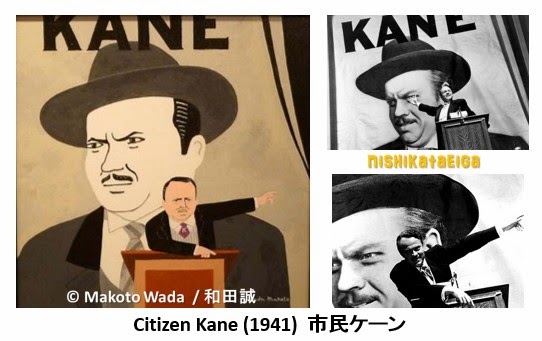

I was amused by how fat Orson Welles' head is in Wada's interpretation of this iconic image from Citizen Kane, because I didn't recall Welles looking so fat-headed in this scene.  But then I discovered that some stills of this scene do make his head extraordinarily large.... and of course Charles Foster Kane was indeed getting progressively big-headed throughout the film in the figurative sense. 


The Puerto Rican singer and actor José Ferrer is not as well-known today as many of his contemporaries (Bogart, Peck, Wayne, Tracy, Stewart), but he was a superstar in his time, winning the Tony in 1947 for playing Cyrano on Broadway before going on to win an Oscar and a Golden Globe for this screen portrayal.  Ferrer was the first Hispanic to win an Oscar.  To hear him in action, his best Cyrano speeches are available on iTunes.  He is arguably the top English Cyrano of the 20th century.  


For more by Wada: 

2015 Cathy Munroe Hotes

03 December 2014

Dot (点, 1971)


In his long and varied career in animation, Shin’ichi Suzuki has worked behind the scenes on many anime classics. He was a key animator on Osamu Tezuka’s unfinished masterpiece Legend of the Forest (森の伝説, 1987), Taku Sugiyama’s classic science fiction anime Phoenix 2772 (火の鳥2772 愛のコスモゾーン, 1980), and Katsuhiro Ōtomo’s ground-breaking Akira (1988).  In addition to key animation and inbetweening, he has worked as a character designer and animation director. 

Anime projects involve a lot of artists and it is not always easy for us as spectators to recognize the contributions of individuals to the process.  Fortunately in the case of Suzuki, he made some independent works in the 1960s and 70s that give us some insight into his talent as an animator and a comic artist.  His short film Dot (, 1971) played at the 8th and last of the Animation Festivals held at Sōgetsu Hall alongside films by fellow innovators such as Goro Sugimoto and Keiichi Tanaami


Dot (点/Ten, 1971), also known as Dots or Spots, opens and closes with self-reflexivity – a look behind-the-scenes at the methods behind the magic of animation.  The overhead camera used to shoot the frame-by-frame hand drawn animation has been placed higher than usual in order to capture not only the page but the animation desk, the animator and all of his assistants.  By increasing the playback speed, the action has been sped up to show the animation team at work.  Upon closer inspection of the sheets of paper being put on the animation table to be filmed, one can make out the names of Suzuki and his crew in Japanese.  Some of the names where difficult to make out because the print was too small, but the ones that I am sure of are: 鈴木 伸一 (Suzuki), 坂東昭雄 (Akio Bandō, the cameraman), 矢沢祐二 (Yūji Yazawa),  佐藤 茂夫 (Shigeo Satō), 西出栄子 (Eiko Nishide, editor), 藤田紘一 (Kōichi Fujita), 明田川 (Susumu Aketagawa, sound), plus four others.  The soundtrack squeals over the opening credits like an old recording playing back at an increased speed.


A larger white piece of paper is placed on the animation table and the camera zooms in to reveal a small black dot.  This is followed by a montage of dots of varying sizes and colours, then a series of vignettes showing dots in various contexts.  A boy in kimono has dots for eyes, one of which repeatedly tries to escape his face but the box keeps placing it back.  A montage of the Chinese character for dot () in different sizes and colours.   A man spills a container of dots and then tries to vacuum them up, but one of the dots resists.  A dog barks at a dot, which transforms into a set of jaws that attacks the dog.  A man tries to pummel a dot but is sucked into the earth.  A man walking gets a dot stuck in his geta (Japanese clogs) and turns himself into a pretzel trying to free his geta.  A team of men play with the dot as if it’s a ball.  A man lights the dot as if it is a bomb, but he himself explodes.  A bird tries to carry off the dot, but it turns into a pole.  A man eats a dot and it goes through his body as if the stomach is a pachinko machine.   The dot turns into the planet earth, and a rocket blasts out of it to an explosion of American flags.  The dot turns into a noose onto which a man is hung to the sound of a toilet flushing.

The soundtrack is a mixture of funky music, pinging noises, sound effects to complement onscreen actions, and found recordings (such as the sound of a rocket launch).  The film demonstrates Suzuki’s skill as an animator, his love of visual gags, and his sense of poetic irony.  It’s a small gem of a film with bonus footage during the opening and closing credits that act as a documentary of how low budget animated films were made in the early 1970s.

Shin’ichi Suzuki (鈴木 伸一, b. 1933)   http://sam.or.jp/


Born in Nagasaki, Suzuki began his career as a manga-ka when he was a high school student, submitting his works to magazines such as Manga Shōnen. In 1956, he joined Otogi Pro under the mentorship of anime pioneer Ryuichi Yokoyama where he worked on the series Instant History (later renamed Otogi Manga Calendar, 1961-64).  Together with his fellow manga-ka Fujio Fujiko, Shōtarō Ishinomori, Jirō Tsunoda, Fujio Akatsuka, and others, he established the short-lived Studio Zero (スタジオ・ゼロ1963-1971).  He has been involved in the production of a variety of animation from indie to mainstream.   Suzuki is one of the founding members of the Suginami Animation Museum and since 2005 has been its director. 


Cathy Munroe Hotes 2014

The Gourd Bottle (ひょうたん, 1976)


The Gourd Bottle (ひょうたん, 1976) is an independent animated short by Shin’ichi Suzuki.  Suzuki belongs to the first generation of post-war indie animators who pushed new boundaries in animation in the 1960s and 1970s.  His short film Dot (, 1971) played at the 8th and last of the Animation Festivals held at Sōgetsu Hall alongside films by fellow innovators such as Goro Sugimoto and Keiichi Tanaami.

A “gourd bottle”, or hyōtan in Japanese, is a bottle made from the calabash fruit (lagenaria siceraria).  It is also variously called “bottle gourd”, “opo squash” or “long melon”.  It is an edible fruit when harvested young, but if left to mature it can be dried and made into a bottle.  In some Asian countries it is also used for making utensils or pipes.

For The Gourd Bottle, Suzuki uses his pared-down caricature style that fans of his manga will be familiar with.  It is a comic tale with a simple, but absurd conceit: a drunk salaryman with a bow-tie is at a bar. He notices that his glass is empty, but rather than ordering another one, he pulls out a gourd bottle from under the table.  The man sitting next to him gets sucked into the bottle, like a reverse of the genie coming out of the lamp in Aladdin, and the drunk shakes the bottle and drinks its liquid.  The barkeep spots the drunk with his own liquor bottle and orders him to leave.  The barkeep also gets sucked into the bottle.  The process repeats itself with others the drunk encounters along his way: a sexy lady, a cop, a dog peeing against the side of the bottle, until he accidentally leaves the bottle on the ground and finds the tables turned on him.


On the whole, it is a relatively simply executed animation, with its minimalist style allowing the audience to focus on the humour.  There are two brief, but brilliant animation sequences: 1) the man pointing the cop’s gun at the “camera” and shooting the gun straight at the spectator and 2) the final sequence in which a car runs over the gourd.  The best gag in the film is when the guy sucks the dog up into the gourd bottle, and when he drinks its liquid wets his own pants.  It’s a comic classic its era in the vein of Marv Newland’s Bambi Meets Godzilla, (1969), Makoto Wada’s Murder (1964), and the films of Yoji Kuri and Taku Furukawa.  Tongue-in-cheek sense of humour meets unadorned, expert animation.

Crew:
Kōichi Fujita / 藤田紘一
Katsumi Ōnishi / 大西克実
Masatoshi Mizumachi / 水町正俊 (Sound)
Akio Bando / 坂東昭雄 (Camera)
Eiko Nishide / 西出栄子 (Editor)

Shin’ichi Suzuki (鈴木 伸一, b. 1933)  http://sam.or.jp/

Born in Nagasaki, Suzuki began his career as a manga-ka when he was a high school student, submitting his works to magazines such as Manga Shōnen. In 1956, he joined Otogi Pro under the mentorship of anime pioneer Ryuichi Yokoyama where he worked on the series Instant History (later renamed Otogi Manga Calendar, 1961-64).  Together with his fellow manga-ka Fujio Fujiko, Shōtarō Ishinomori, Jirō Tsunoda, Fujio Akatsuka, and others, he established the short-lived Studio Zero (1963-1971).  He has been involved in the production of a variety of animation from indie to mainstream.   Some of the big name projects he worked on include Phoenix 2772 (Taku Sugiyama, 1980), Akira (Katsuhiro Ōtomo, 1988), and Legend of the Forest (Osamu Tezuka, 1987).  Suzuki is one of the founding members of the Suginami Animation Museum and since 2005 has been its director.  

Cathy Munroe Hotes 2014

01 December 2014

Japanese Auteur Animation at RICA Wissembourg, Part 2: The Invention of the Animation Auteur


Japanese Auteur Animation at RICA Wissembourg, Part 2: The Invention of the Animation Auteur
« L'animation japonaise d'auteur » presented by Ilan Nguyen


Screening One / Programme 1ère partie                  22 Nov. 2014, La Nef, Wissembourg

The Invention of the Animation Auteur
L'invention de "l'animation d'auteur"

Clap Vocalism / Human Zoo /人間動物園 (Yōji Kuri, 1962)
Love /   (Yōji Kuri, 1963)
Mermaid / 人魚 (Osamu Tezuka, 1964)
The Flower / (Yōji Kuri, 1967)


The idea of a Japanese animation auteur was arguably invented by experimental artist Yōji Kuri (久里洋二, 1928) in the 1960s.  A member of the Animation Group of Three (アニメーション三人の会), who inaugurated a series of animation festivals at the Sōgetsu Art Center in Tokyo, Kuri was also the first indie animator to actively promote his work at international festivals.  Kuri was a part of the counter-culture movement of the 1960s and his avant-garde, racy animated shorts shocked and delighted festival audiences in equal measures.  Nguyen screened Kuri’s 1962 film Clap Vocalism, which won the Special Jury Prize at the third Annecy (1963) and the bronze medal for animation at the 24th Biennale in Venice (1963).  Click here to read my full review of the film.  The programme also included the Kuri classics Love (read review) and Flower (review forthcoming).  Nguyen described Kuri’s style as anti-commercial and minimalist, with musique concrète.  His style and themes need to be understood in the context of the 1960s era of counter-culture that were formative for him. 


Whereas Kuri sought to shock and surprise with his art, his fellow animation auteur Osamu Tezuka ( 治虫, 1928-89) sought to impress.  When the Animation Group of Three expanded into the 1st Animation Festival, Tezuka was one of a handful of animators to present their cutting edge works.  Nguyen showed Mermaid, one of two films that Tezuka presented at that festival.  Inspired by Claude Debussy’s symphonic poem Prélude à l'après-midi d'un faune (arranged by Isao Tomita), Mermaid is an Orwellian tale of a young man’s unwavering desire for freedom in the overwhelming face of modernism.  The character design in minimalist, with Shigeru Yamamoto doing the original art and Kiyomi Numamoto assisting with the animation.

Independent production of the 1970s 
La production indépendante dans les années 1970

Made In Japan (Renzō Kinoshita, 1972)
Stone (Nobuhiro Aihara, 1975)
Karma / カルマ (Nobuhiro Aihara, 1977)
Coffee Break  / コーヒー・ブレイク(Taku Furukawa, 1977)
Pica-Don   / ピカドン (Renzō Kinoshita, 1978) 
Bubble   / バブル (Shin’ichi Suzuki, 1980)


Another artist acutely aware of the changing face of Japan was Renzō Kinoshita (木下蓮三, b. 1936-97) who founded the Hiroshima InternationalAnimation Festival in 1985 together with his wife and artistic collaborator Sayoko Kinoshita (木下小夜子, b. 1945) (learn more about him).  Kinoshita’s films are concerned with social issues and Nguyen chose to open and close this section of his talk with key works by this innovative cutout animator.   Made in Japan (1972) is Kinoshita’s critique of the rapid modernisation of Japanese culture.  With tongue firmly in cheek, this film mocks the commercialism of 1970s Japan and explores controversial themes such as the Americanisation of Japanese culture, the destruction of traditional values in the pursuit of money. 


Made in Japan was followed by two films by Nobuhiro Aihara (相原信洋, 1944-2011), an experimental animator who hit his stride in the 1970s.  Although Aihara loved to travel overseas and meet fellow artists abroad, his works are rarely shown outside of Japan. The only works that are readily available are the collaborations he did with pop artist and colleague at Kyoto University of the Arts Keiichi Tanaami, which appear on DVDs released in Japan and FranceStone (1975) is an experimental animation shot using pixilation and other avant-garde techniques during a six-month stay in Sweden.  Key images include Rorschach paintings on paper shot on natural stones and a time-lapse sequence of a brick house being painted shot with a fisheye lens.   Karma (1977) has a more psychedelic feel to it, thanks in part to the soundtrack – “Aegean Sea” by Greek psychedelic / progressive rock band Aphrodite’s Child.  The swirling, mandala-like imagery is a characteristic motif of Aihara’s work, appearing in many of his animations, paintings, and illustrations (see: Hiroshima 2010 poster).  Learn more about Aihara in the obituary that I wrote in 2011.


Taku Furukawa (古川タク, b. 1941) is one of the best known independent animators in Japan.  He began his career being mentored by Kuri, but then went on to found his own studios.  His pared-down caricature style was heavily influenced by the style of the New Yorker cartoonist and illustrator Saul Steinberg.  Furukawa won the Special Jury Prize at Annecy in 1975 for his innovative film Phenakistoscope and the Bungeishunjū Manga Award for his publication The Takun Humour in 1978.  A few years ago he succeeded Kihachirō Kawamoto as the president of JAA (the Japanese Animation Association).  Nguyen presented one of Furukawa’s classic work Coffee BreakRead my review of it here.


Shin’ichi Suzuki, who featured in the first part of Nguyen’s presentation for his work at Otogi Pro, went on to found his own production company Studio Zero in 1963.  Nguyen was unable to get his animated short Bubble as originally planned, so he showed The Gourd Bottle (ひょうたん, 1976) instead.  It’s a very funny, caricature style short about a drunk with a magic gourd bottle (aka calabash – a squash-like fruit that can be dried and used as a bottle).  Suzuki has been the director of the Suginami Animation Museum since 2005.

Nguyen chose to close the 1st of his 2 programmes with Kinoshita’s 1978 film Pica-don.  I thought that this was a good idea because the experience of watching Pica-don, an animated depiction of the bombing of Hiroshima based upon witness testimonies and drawings, is very intense.  One really needs some quiet time afterwards to process the horror that the film evokes.  Read more in my full review of the film and accompanying picture book. 

Catherine Munroe Hotes 2014

Next:


30 April 2014

Rain Won’t (雨ニモマケズ, 2013)


 “Ame ni mo makezu” (Be not Defeated by the Rain) is one of the most famous poems in the Japanese language.  Written by beloved author Kenji Miyazawa, the poem was discovered among his possessions after his passing in 1933.  Like Max Ehrmann’s “Deriderata” (1927), “Ame ni mo makezu” is a kind of a mantra or a musing on how to live one’s best life.

This bilingual picture book edition Rain Won’t (ニモマ/ Ame ni mo makezu, 2013), has been translated by American poet and translator, Arthur Binard and illustrated by renowned animator Kōji Yamamura.  In the afterward, Binard suggests that he wanted to recapture the lost traditional landscapes of Miyazawa’s Iwate Prefecture. “Kenji lived in a land where people grew, raised, and caught all their food.  Now more than 60 perfect of what’s eaten in Japan is imported,” Binard writes, and goes on to lament the loss of arable lands and free-flowing rivers to commercial urban streetscapes and concrete riverbanks.  Binard seems to be using Miyazawa’s words as a rallying cry against nuclear power and multinational corporations and in favour of a return to living in harmony with the environment.

our Miyazawa noren

This message resonates very strongly for my family because this poem has special meaning to us.  My husband specialises in sustainable agriculture and shortly after the disaster of 3/11 we were visited by friends/colleagues from Japan.  One of them, brought us a noren from Iwate and told us what a close call he had the day of the Tohoku earthquake and tsunami (see intro to: Anime Adaptations of Kenji Miyazawa’s Stories and Poems to read full story).  Iwate is just north of Fukushima and was badly affected by the 2011 tsunami.  As part of the redevelopment of this area, some researchers are looking at how to restore Satoyama landscapes.

Order from amazon.co.jp.
With his lovingly drawn illustrations, Koji Yamamura has managed to capture the beauty and diversity off the Satoyama landscape of Miyazawa’s time (early Shōwa period).  Satoyama (里山) is the name of the landscape that is cushioned between the mountain foothills and arable land.  It “is characterized by a mosaic feature of different land uses such as woodland, grassland, paddy field, farmland, irrigation ponds and canals, and human settlements, which have been maintained in an integrated manner.” (source: satoyama-initiative.org).  Simply put, it is a landscape in which humans and the natural world are living in harmony with one another.  The most famous example in Japanese popular culture is the rural landscape that the Kusakabe family (Mei, Satsuki and their Dad) move to in Hayao Miyazaki’s My Neighbour Totoro (1988).


Using a limited palette (green, brown, yellow, a little bit of red), Yamamura not only depicts the landscape suggested by the original poem, but also adds depictions of the creatures that thrive in a Satoyama landscape.  This includes a variety of insects (dragonflies, grasshoppers, ladybugs, wasps, etc.), birds (tits, swallows, egrets, owls, etc.), and mammals (tanuki, domestic animals), and, of course, people.   

The result is a beautiful picture book edition of Rain Won’t (ニモマゲズ/ Ame ni mo makezu, 2013) that is fully bilingual and can be enjoyed by the whole family.  Although it looks like a typical children’s storybook, the language and philosophy is geared more to an adult reader.  The illustrations are very detailed – the kind of book you can read again and again and always spot something new.

Order from amazon.co.jp.
Catherine Munroe Hotes

My thanks to Koji Yamamura for his generosity.


11 February 2012

The World of Kato Kunio


Hachioji Yume Art Museum Special Exhibition: The World of Kato Kunio
八王子市夢美術館特別展 加藤久仁生展
Hachioji Yume Art Museum
10 February – 25 March 2012

On Friday, the Hachioji Yume Art Museum launched its special exhibition celebrating the career so far of Oscar-winning animator Kunio Katō (加藤久仁生, b. 1977).  Since winning the Oscar for Best Animated Short Film for La maison en petits cubes (つみきのいえ/Tsumiki no ie, 2008), Katō has keep a relatively low profile internationally.  He has; however, indeed kept busy creating an animation campaign in celebration of the 40th anniversary of Sekisui Heim (セキスイハイム) among other projects for his company ROBOT.  There have recently been rumours that Katō may be involved in the production of the animated adaptation of Khalil Gibran’s poetry collection The Prophet (Roger Allers, Sylvain Chomet, et al., 2013).

still from Sekisui Heim animated CM

A graduate of Tama Art University, where Katō was introduced to animation by the influential animator Masahiro Katayama, Katō quickly became the darling of Japan’s indie animation scene with his short films The Apple Incident (2001), Fantasy (2003) and his web series The Diary of Tortov Roddle (2004).  Before winning the Oscar, he had already been the recipient of many laurels including twice winning the Yuri Norstein Prize at Laputa as well as top awards at international festivals including the Japan Media Arts Festival, Hiroshima, and Annecy.

The exhibition, which was put together in collaboration with the designer Makoto Koizumi (小泉誠), features sketches, storyboards, and original illustrations from the production of La maison en petits cubes.  One can follow the production process step-by-step and learn about how this exceptional animated short came to life.  In addition, the exhibition features work Kato has done since winning the Oscar – sketches from Atogaki (あとがき/Postscript) a regular feature by Kato published in the animation magazine MOE.


 The highlight of the exhibition is Katō’s latest animated short  Jōkei (情景, 2012) which he made especially for this event.  In addition, Kenji Kondo, the composer of the La maison en petits cubes soundtrack, and the Kuricorder Quartet (栗コーダーカルテット) will perform music from the film at nearby Ichō Hall on February 16th


For more information and a slideshow of images from the event, go to Yumebi.com (JP only).

Hachioji Yume Art Museum                                                                                                                   
2F View Tower Hachiouji
 8-1 Youkamachi, Hachioujishi
Tokyo 192-0071
Tel.  0426-21-6777 Fax 0426-21-6776
10:00-19:00
For directions to the event see Tokyo Art Beat (EN/JP)

17 December 2011

Shiba Productions' The Little Tin Soldier (1968)


I have recently begun collecting the 3D “Living Storybooks” designed and manufactured by Shiba Productions in the 1960s.  They were distributed in North America by the New York-based publisher Golden Press.  Shiba Productions was a puppet animation studio that was founded in 1958 by three men: writer/editor Tadasu Iizawa (飯沢 , 1909-1994), artist/designer Shigeru Hijikata (土方 重巳, 1915-1986), and puppet maker and animator Kihachirō Kawamoto.  Kawamoto would go on to become the most famous of the three men but at the time he was an artisan and not yet a director/artist in his own right.  The studio specialized in puppet animation for television commercials.  In addition to animation, Shiba Productions also created puppets for picture books, magazines, and print advertising.

click to enlarge

Kawamoto had first worked for Iizawa during the Tōhō strikes of the 1940s.  He was hired as an assistant art director by Tōhō in 1946.  His mentor was the acclaimed art director and production designer Takashi Matsuyama (松山崇, 1908-1977).  After getting the opportunity to work on three major feature films, Kawamoto found himself on strike with his colleagues.  During the strike, Matsuyama got Kawamoto some work at Asahi Graph, a weekly pictorial magazine run by Asahi Shinbun that ran from 1923-2000.  When Kawamoto was eventually dismissed from Tōhō in 1950, he seems to have worked together with Iizawa and Hijikata on a number of commercial projects.  Iizawa was the one who introduced Kawamoto to the stop motion animation pioneer Tadahito Mochinaga (持永只仁, 1919-1993) when he returned to Japan from China in 1953.  It was from Mochinaga and his wife that Kawamoto learned the basics of puppet animation. 

click to enlarge
At Shiba Productions, it would seem that Iizawa played a kind of producer/writer role and Hijikata was the designer of the characters.  Kawamoto crafted the puppets by hand and was in charge of the animation – or in the case of the “Living Storybooks” photo shoots of the puppets.  He drew quite heavily on what he had observed as an assistant art director at Tōhō for this.  In an interview with Jasper Sharp in 2004, Kawamoto explained that he considered the dolls that he used in the storybooks “puppets” because to him “they were actors within the books.”


The first “Living Storybook” in my collection is The Little Tin Soldier (aka The Steadfast Tin Soldier)  by Hans Christian Andersen.  As these books were very popular with children, it is rare to find one in mint condition.  My copy (see image above) has well worn edges but the binding itself is intact. 

The books were called “3D” or “Living Storybooks” not only because they feature photographs of three-dimensional puppets and sets, but also because the front cover features a full colour hologram.  This novelty cover meant that the books were quite eye-catching when displayed on the shelves of bookstores and libraries.  It also made the storybooks quite memorable for children who grew up with them. 

The Little Tin Soldier has thick card pages and features 18 full colour pages and 14 black and white pages with text.  The monochromatic images of the puppets are less satisfying than the full colour pages because the images have been rather awkwardly cut out in order to have them alternate with the text.  The best monochromatic pages are the ones that have used illustrations to give the tin soldier floating down the river in his paper boat a setting. 
click to enlarge
The story is faithful to the original version of Andersen’s Steadfast Tin Soldier (Den standhaftige tinsoldat/しっかり者のスズの兵隊, c. 1838), so it does not have a happy ending.  .  .  at least not in the way most parents today would expect.  I rather like how the story ends with a random act by a child.  It seems a much more likely scenario for a tin soldier than a happily ever after ending.

The puppets and sets are all consummately designed and crafted.  The most striking image by far is that of the tin soldier and ballet dancer in the blazing fire.  Although there are certain design elements that make the book recognizable as being a product of the 1960s (ie. the title font, choice of colours, the modern looking castle and toy elephant), on the whole most of the puppets and sets have been designed in a way that references 19th century European toys and design.  It is a beautiful, highly collectable book.  


References: 
Heibonsha’s Kawamoto Kihachiro: Ningyo Kono inochi aru mono (2007)
Takayuki Oguchi’s interview with Kawamoto: Animation Meister at Japan Media Arts Plaza’s website.


Catherine Munroe Hotes 2011


14 September 2011

URSA minor BLUE (銀河の魚, 1993)


Shigeru Tamura’s animated short URSA minor BLUE (銀河の魚/Ginga no Sakana, 1993) begins with a simple scene that could be right out of an Ernest Hemingway novel: a grandfather fishing with his grandson. The grandson, Yuri, is quite able with the hand-thrown harpoon and he soon catches an impressive fish for their supper.  As they return home with their catch, Teshikai Utollo’s otherworldly music hints that all in this world may not be the same as in ours. The grandfather sends Yuri to find tomatoes for dinner and we discover that they have an indoor rain forest complete with a lemur-like creature whose eyes shine like headlights. The tomatoes that Yuri picks seem to pulsate with a strange light.

While the grandfather comically burns their dinner, Yuri ascends to the observatory above their home. Looking through an unusual telescope he discovers that the constellation of Ursa Minor appears to be missing a star. The pair set off in their rowboat again to try to find out what is going on. They pass through a talking forest and a rocky area with mythical flying beasts. Along the way, a walking and talking building approaches them and voices his concern that stars seem to be missing from the Milky Way. They reassure him that they are going to investigate and return the Milky Way to its original state.


As they head out over what appears to be open sea, Tamura (たむら しげる, b. 1949) shifts to an overhead perspective and we then realize that Yuri and his grandfather do not live in our world but rather above it. The sea that they are rowing across is the atmosphere and they are able to look down at a world that resembles ours. As they journey out into the universe, they witness a giant fish unlike any they have ever seen.  They come to a place where giants who seem hewn from rock appear to be forging stars on giant anvils and are greeted by the wizard who lives there. They soon learn that a giant fish has been eating the stars and the wizard presents Yuri with a magic harpoon and sends him on a mission to try to catch the fish in order to return the Milky Way to its normal state. Hence the Japanese title Ginga no Sakana, or Fish of the Milky Way.

The grandfather also refers to the Milky Way by its colloquial name Ama no gawa (天の川), or River of the Heavens, which suggested to me that Tamura was influenced by mythology in his creation of his fabulous world. In East Asian mythology it is said that the Milky Way resembles a kind of silvery river and mythological stories developed around this impression. The most famous is that of the stars Vega and Altair, who were said to be lovers (named Orihime and Hikoboshi in Japanese) separated by the Milky Way who could only meet once a year on the seventh day of the seventh month – a day celebrated in many parts of Japan as Tanabata (七夕/the evening of the seventh). The mythology surrounding the Milky Way has inspired much great literature – most famously Kenji Miyazawa’s Night of the Milky Way Railroad, which Tamura references by having a train pass under Yuri and his grandfather as they row across the sky. 


As the English title suggests, colour is an important element of Tamura’s work. The predominant colour in this film is blue, but there are also wonderful scenes of green and orange when they visit the wizard. This style of filling the screen with bold colours is characteristic of Tamura’s aesthetic. His manner of completely filling the screen with colour reminded me of two younger animators: Tomoyoshi Joko – who also made a wonderful little film involving anthropomorphic buildings called simply Buildings (2008) – and Oscar winner Kunio Katō.  .  .  although Katō uses a more muted palette to fill the screen than the cheerful colours of Shigeru Tamura.

URSA minor BLUE won the Noburo Ofuji Award in 1993 and is available on DVD. The DVD extras include a music section where Teshiaki Utollo explains the motivations behind his expressive soundtrack, an illustration gallery, storyboards, layouts, interviews about the production with Tamura, Utollo, and producer Mitsuo Shionaga, and trailers for Tamura’s other animated works a piece of PHANTASMAGORIA (1995) and Glassy Ocean (1998). The soundtrack for URSA minor BLUE can also be purchased separately.  Check out more of Tamura's illustrations on his official homepage.  

URSA minor BLUE / Animation Soundtrack
URSA minor BLUE (soundtrack on CD)


This review is part of Nishikata Film Review’s  Noburo Ofuji Award Challenge.


text © Catherine Munroe Hotes 2011

11 July 2011

Taku Furukawa “A Playful Heart” Exhibition: “From a Single Line”


A retrospective of the career of Japanese alternative animation pioneer Taku Furukawa has opened this week at the Kichijoji Art Museum in Musashino. Furukawa (古川タク, b. 1941) has worked as an animator, illustrator, teacher and mentor for over 40 years.  He has won many prestigious awards in his career including the Special Grand Jury Prize at Annecy (1975), the Bungeishunju Manga Award (1978) for his book The Takun Humor, and the Noburo Ofuji Award (1980). 

The exhibition is called Taku Furukawa “A Playful Heart” Exhibition: “From a Single Line” (古川タク展「あそびココロ」“1本の線から”). “From a Single Line” refers to his minimalistic line drawing aesthetic. Furukawa has cited the influence of renowned New Yorker illustrator Saul Steinberg (1914-1999) on his trademark style. Furukawa was also influenced early in his career by his mentor Yōji Kuri (久里洋二, b. 1928). Furukawa worked his way up at Kuri’s studio in the 1960s, eventually doing key animation on many important films such as AOS (1964) and Au Fou! (1965). In 1966, he ventured out as a freelance animator, eventually forming his own studio, Takun Box, in 1970.

The “Playful Heart” in the title of the exhibition refers not only to Furukawa’s tongue-in-cheek sense of humour in his art, but also to playful spirit with which he approaches animation. Handmade films like Nice to See You (1974) follow in the experimental traditions of animators like Norman McLaren, Len Lye, and Oskar Fischinger. In Calligraphiti (1982), Furukawa even experiments with direct animation which involves drawing directly onto the film stock itself.

Furukawa’s most notable work combines his experimental tendencies with his playful sense of humour. In Phenakistoscope (Odorokiban, 1975), the film that won him the prestigious Special Grand Jury Prize at Annecy, Furukawa drew his inspiration from the 19th century pre-cinema device of the same name. Using frame-by-frame hand drawn animation techniques, Furukawa replicates the Phenakistoscope discs, animating all 18 stages of successive action at once. Some of the images he depicts are nods to the original subjects of the Phenakistoscope discs, such as a couple dancing, but he moves away from just recreating human movement into a realm of fantasy and the colourfully abstract: a skyscraper with looping freeways above it transforming into a tree, a bride and groom with their bodies elongating and shrinking like an accordion, a woman drinking soda through a straw whose head turns into a bubble that floats away. (Read my review of Phenakistascope to learn more and see same Phenakistascope illustrations).

Not only does Furukawa adapt old technologies to modern sensibilities, but when personal computers came on the scene in the 1980s he also demonstrated a willingness to experiment with new technologies. To the contemporary spectator, the playful doodle animation Mac the Movie (1985) seems unsophisticated to us today; however, it is significant as an early example of animation on an Apple Mac personal computer. The first Macintosh, with its groundbreaking graphics painting software program MacPaint, had only just been introduced the year before in January 1984. Furukawa highlights the playful nature of this experimental film by employing an equally lighthearted soundtrack: a synthesizer interpretation of ‘Singing in the Rain’. Qualities specific to this early personal computer technology include the flicker of the screen and the extra large pixel sizes. Play Jazz (1987) offers a more sophisticated early example of computer animation (I am guessing he did this on a Macintosh II because it’s in colour – the title may be a reference to Lotus Jazz), due in part to the advances in computer technology. The improvisational nature of the Matisse-inspired animation is reflected in the jazz music soundtrack. This combination of experimentation, improvisation, music and animation inevitably reminds one of Norman McLaren and Evelyn Lambart’s interpretation of Oscar Peterson’s jazz music in Begone Dull Care (NFB, 1949).

To learn morea bout Taku Furukawa, you can read my reviews of his films Speed, which won the Noburo Ofuji Prize for 1980 and Jyōkyō Monogatari (aka Tyo Story, 1999) - an animated reworking of Yasujiro Ozu's Tokyo Story (1953). He also made a number of shorts for the long-running NHK series Minna no Uta.
ORDER NOW

In addition to showcasing a selection of Furukawa's animations, illustrations and drawings, this exhibition also features installations by Furukawa.  If you are not lucky enough to be in Tokyo for this event, you can support this artist by ordering a selection of Furukawa's works from Anido.  

Taku Furukawa “A Playful Heart” Exhibition: “From a Single Line”
古川タク展「あそびココロ」“1本の線から”  (English info)
July 9th – August 14th

Kichijoji Art Museum
FF Bldg. 7F, 1-8-16 Kichijoji Hommachi, Musashino-shi, Tokyo 180-0004
Phone: 0422-22-0385 Fax: 0422-22-0386