Showing posts with label NFC. Show all posts

20 May 2017

Urashima Tarō (浦島太郎, 1918)


Urashima Tarō (浦島太郎, 1918)
dir. Seitarō KITAYAMA (北山清太郎)

Seitarō Kitayama’s 1918 short animation Urashima Tarō (浦島太郎, 1918) was considered lost for over 60 years until it was rediscovered along with Jun’ichi Kōuchi’s The Dull Sword (なまくら刀 / Namakura Gatana, 1917) in an Osaka antique shop in 2008 by visual culture historian Natsuki Matsumoto (source).  It is the only extant work of at least 8 animated shorts that were made in Japan in 1918.  The film was digitally restored from Matsumoto’s 35mm tinted silver nitrate positive copy and was screened at the NFC in 2008 as part of a programme called Cinema Lost and Found 2008 (発掘された映画たち2008) .  It  and can now be viewed online in the NFC’s Animation Film Archives as part of their celebration of the centenary of animation production in Japan.

The animation is an adaption of the well known folk tale of the same name.  The earliest known record of the name Urashima Tarō is in an otogizōshi (御伽草), a kind of illustrated prose narrative, from the Muromachi era (c. 15th century).  However, the story itself dates back even further to the Nara period, where it appears in such works as the Nihon Shoki (The Chronicles of Japan) and the Man’yōshū (Collection of Ten Thousand Leaves) under the name Urashimako.  

It is a kind of a Rip Van Winkle tale but instead of falling asleep, the main protagonist goes out to sea on the back of a turtle.   After many adventures (there are many variations of the tale), he returns home to find that hundreds of years have past.   In Japanese culture, Urashima Tarō is a short hand expression for that feeling one has returning home after a long absence and feeling out of place. 

It was clever of Kitayama to choose a familiar story, because with such a short animation (under 2 minutes running time) he did not have a lot of time to waste on exposition.  The short begins with Urashima Tarō with his back to the camera walking to the sea with a fishing rod slung over his shoulder.  In the next shot, he paddles his boat from bottom screen right to top screen left.  The next shot using an iris matte to focus on Urashima Tarō fishing peacefully in his boat.  This is followed of an extreme long shot of Urashima Tarō struggling in his boat, in now choppy waters, with menacing figures of large fish under the water.


He falls to the sea floor, where is appears to cry until he is rescued by a large turtle who tells him to climb onto his shell.  The sequence of Urashima Tarō travelling on the turtle’s back is shot using silhouette animation.  He appears to arrive at a palace where he is escorted by humanoid figures with fish heads.  Cut to a princess standing in the window who appears to beckon in a friendly manner.  Iris in.  Iris out to outside of the palace.  A large bubble exits the palace door and floats upwards.  Urashima Tarō bursts from the bubble back onto the shore.  His costume is the same but he is now an elderly man.  He appears to laugh.  End title cards.

Without the benefit of the benshi narrator, who would have accompanied the film when it was first screened, the nuances of the story have been lost.  The facial expressions, gestures, and use of the absurd (fish headed people) suggest the film was meant to be humorous.  The choice of red tinting (the NFC describes it as “pink”) is unusual because red was usually used in silent films to indicate scenes of fire or immense passion.  Logically one would expect the underwater sequences to have been tinted in blue and the island sequences in yellow to indicate sunlight.  Perhaps light red was the only tint available to Kitayama at the time – although Jun’ichi Kōuchi did use a blue/green tint and a yellow tint for The Dull Sword (1917).  I will update if I find any information about the use of tinting in Japan during this period.

Although the film is very short, Kitayama manages to demonstrate a number of techniques including cutouts, silhouette animation, irises, and the use of three layers of space.  As we only have two extant films from the many made during 1917 and 1918, this film is an important glimpse into the abilities of Kitayama and his fellow animators at this time.

I am not sure what name is indicated by the initials Y.N. in the end credit.  The NFC lists the production company as Nikkatsu Mukojima Studio (日活向島), for whom he worked until he established his own studio Kitayama Eiga Seisakusho (北山映画製作所) in 1921.  The studio was unfortunately destroyed by the Great Kantō Earthquake in 1923 leading Kitayama to give up animation and move to Osaka where he worked as a newsreel cameraman (Learn more).

2017 Cathy Munroe Hotes

13 March 2017

The Dull Sword (なまくら刀, 1917)


Japan is celebrating the centenary of anime this year. Due to the paucity of early cinema records in Japan there is much debate as to when exactly animation was first publicly screened in the country. However, we do know that the 1910s saw screenings of foreign works by Émile Cohl, James Stuart Blackton, James Randolph Bray, and Raoul Barré. There is also evidence that many people were experimenting with the animation medium before 1917, but it was the year that the first studio was organised to make animation for public screenings. 

The cartoonists Ōten Shimokawa (下川凹天, 1892-1973), Seitarō Kitayama (北山清太郎, 1888-1945), and Jun’ichi Kōuchi (幸内純一, 1886-1970) produced at least 20 short animated films in 1917. The earliest of these is generally thought to have been Shimokawa’s The Story of the Concierge Mukuzo Imokawa (芋川椋三玄関番之巻, 1917), but there is evidence that there may have been an earlier work. You can read “Some remarks on the first Japanese animation films in 1917” by Frederick S. Litten to learn what is known about this time period. 

What is clear; however, is that almost all the Japanese animation films from the 1910s have been lost. Jun’ichi Kōuchi’s The Dull Sword (なまくら刀 / Namakura Gatana, 1917), also known as The Sword of Hanawa Hekonai (塙凹内名刀之巻 / Hanawa Hekonai meitō no maki), is the earliest known extant work. The Dull Sword and Kitayama’s Urashima Taro (1918) were miraculously discovered in an Osaka antique shop in 2008 (source). The film originally debuted on 30th of June 1917. 

Watch a news item on the discovery: 


A one-reel silent film, The Dull Sword was digitally restored and can be screened on the National Film Centre’s film archive website with subtitles by Dean Shimauchi

The film has a couple of title cards, but much of the apparent dialogue is un-titled. It is likely that these segments of dialogue were filled in by a benshi, or film narrator, as was standard practice in Japanese silent cinema. Watching the film completely silent on the NFC archive website, without the comic interpretation of a benshi, means that the full comic impact of the film is greatly reduced. One of the title cards is actually on its side (90° clockwise). The film was found with this splicing error and left as it was found by the restoration team.

The Dull Sword is a slapstick comedy, which was a popular genre of the silent period. It is likely Kōuchi and his early animation peers would have been familiar with imported comedies of the day such as the films of “the first international movie star” Max Linder of France, and American slapsticks such as those of Fatty Arbuckle, The Keystone Cops (1912-1917), and Charlie Chaplin. There are also elements of slapstick in many Japanese theatrical traditions such as manzai (漫才) and kyōgen (狂言). Add to the mix that Kōuchi was already an established mangaka and caricaturist when he made The Dull Sword, comedy would have come naturally to him. 


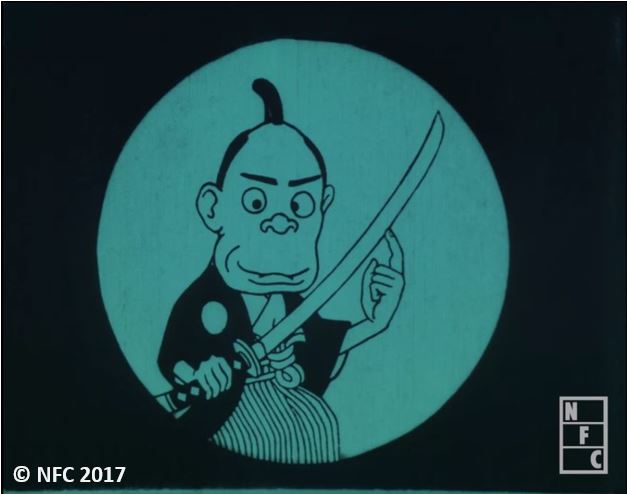
The opening title card, tinted yellow, immediately sets the scene as a jidaigeki with the profile of a samurai and a bent sword. The first section of the film is tinted a dark cyan. A samurai appears in an iris shot examining his sword and testing it for sharpness. His eyes roll comically and his sword overlaps the iris matte in a cinematic visual gag. He cuts his finger on the sword then takes it to the swordsmith “Dull Smith”. The dialogue between the swordsmith and the samurai does not have title cards, but it is clearly humorous in nature with much eye-rolling from both men. There is a slapstick routine of the samurai trying and failing to sheath his sword. Once the sword is finally sheathed, the samurai pays the swordsmith and leaves. 

In the next scene, the samurai is walking along the riverbank across from a large town. He gets out his sword and examines it. A title card reveals his desire to try out the sword. The film cuts to a bald, blind man with a cane playing a flute next to a tree. The samurai approaches him from behind. A yellow-tinted title card reveals that the samurai sees the blind man as a possible person to test his sword out on. He says something (presumably threatening judging from his facial expression) to the blind man. The blind man surprises the samurai by jumping up and kicking him in the face with his geta-clad feet. 

The remainder of the film is tinted yellow. The style is also different with silhouette figures instead of detailed caricatures. A traveller with his luggage on a stick carried over his shoulder is running through the forest and encounters the samurai. The samurai tries to attack him, but the traveller outwits him, hitting him on the head with his stick. The traveller runs away as the samurai struggles to raise his head. Via a speech bubble, the samurai accuses the traveller of being a murderer. The samurai tries to stagger off using his sword as a cane, but it breaks and he falls on his face. He throws the useless sword away. He exits frame left and the film concludes with a company logo reading Y.N. & Co. I am not sure what the Y.N. stands for as Kōuchi made the film for the short-lived company Kobayashi Shōkai (小林商会, 1914-17) run by Kisaburō Kobayashi (小林 喜三郎, 1880-1961) 

The film was transferred to digital format at 16 fps. There were many frames missing from the two film fragments (the cyan-tinted fragment and the yellow-tinted fragment) that had to be compensated for during the film restoration. The final restoration consists of a total of 3,180 frames. For such an early work, the animation is done quite well. Much of the cyan fragment has been hand drawn with cutouts used to save money and celluloid. I am not sure why the film switches to silhouette for the second half. The reason may be budgetary rather than stylistic. My own personal view is that such a short film would have been stronger if it had stuck to one style throughout. 


The most interesting thing about The Dull Sword is its use of a Japanese setting and subject matter. According to Jonathan Clements, the film received praise at the time for doing so (Anime: A History, p. 29). Before the discovery of these earliest works, we only had examples of anime from the 1920s-1940s which demonstrated the influence of popular American character design like Mickey Mouse, Popeye, Betty Boop, and Felix the Cat. This earliest extant anime has been drawn in a caricature style typical of the 1910s and the character design is such a contrast with today’s manga and anime styles. It is a wonderful glimpse into a film culture that we know so little about, due to the destruction wreaked by the Great Kantō earthquake if 1923, the firebombing of Tokyo, the flammability of early film stock, and the general neglect of early films after their initial screening runs. I hope one day to see this film interpreted by a benshi performance in order to get the complete cinematic experience. 
 Cathy Munroe Hotes 2017

25 February 2017

Japanese Animated Film Classics / 日本アニメーション映画クラシックス


Japanese Animated Film Classics / 日本アニメーション映画クラシックス

The National Film Center in Tokyo is celebrating the centenary of Japanese animation this year.  While the exact date that the first animation was made in Japan is uncertain as many people were experimenting privately with cinematic technology in the early years, 1917 is the year that the first commercially produced Japanese animated films were publicly screened.  This included short works by Ōten SHIMOKAWA (下川凹天, 1892-1973), Seitarō KITAYAMA (北山清太郎, 1888-1945), and Jun’ichi KŌUCHI (幸内純一, 1886-1970).

Thanks to funding from Japan’s Agency for Cultural Affairs as part of the National Project for the Sustainability of Born-Digital Cinema, the NFC has selected 64 works released between 1917 and 1941 and made them available for screening online complete with fresh subtitles by Dean Shimauchi (Rosemary Dean and Tetsuro Shimauchi).  Other subtitling was done by Masa Yoshikawa (Burglars of Baghdad Castle, Nonsense Story) and Ayako Kawakita and Tim Olive (The Nation of Fish, A Wolf is a Wolf, Rascal Raccoon).   and Many of these works have never before been available on DVD with English subtitles, let alone in a digital online format. Several films, particularly the abstract works of Shigeji Ogino, have no titles.


The most exciting of these are the two earliest extant anime The Dull Sword (Namakura Gatana, 1917) and Urashima Tarō (1918) – films which were considered lost until copies were miraculously discovered in an antique shop in Osaka in 2008.  As the vast majority of pre-war films have been lost due to natural disaster, war, and general neglect, each of these 64 films is an important glimpse into early anime history and early 20th century Japanese culture.  They represent a wide variety of genres including slapstick comedy, record talkies, documentary, propaganda, and experimental. 

As these films were made for the domestic market, they do not have official international titles.  Several titles have been translated in various ways over the years.  I have left the English titles as posted by the NFC.  On the Japanese Animation Filmography Project, I list alternate titles.  Some of the animations are of completely unknown origin as the films do not have credits.  Very little is known about the animator Hakusan Kimura apart from his films. 

The website information is currently mainly in Japanese only, but the NFC assures us that they are working on an English version that they hope will be available sometime in the next two months.  In the meantime, to help you negotiate the website, I have created links to the profiles of animators and a chronological list of the 64 films.  This is by no means all of the extant pre-war Japanese animation works, but it is a tremendous start and I hope that the NFC will be able to extend this project in the coming years. 

The website features profiles of the following early anime pioneers:

Ikuo OISHI (大石郁雄, 1902-1944), 1 film available
Shegeji OGINO (荻野茂二, 1899-1991), 7 films available
Hakusan KIMURA (木村白山, ????-19??), 2 films available
Mitsuyo SEO (瀬尾光世, 1911-2010), 4 films available
Yasuji MURATA (村田安司, 1898-1966), 23 films available
Noburō ŌFUJI (大藤信郎, 1900-1961), 11 films available
Seitarō KITAYAMA (北山清太郎, 1888-1945), 1 film available
Jun’ichi KŌUCHI (幸内純一, 1886-1970), 2 films available
Kenzō MASAOKA (政岡憲三, 1898-1988), 2 films available
Sanae YAMAMOTO (山本早苗, 1898-1981), 9 films available

In addition, the website features an extensive virtual exhibition of the career of Ōfuji, who was one of the first Japanese animators to achieve international recognition.
 

The available films in order of release are:
1917 The Dull Sword / なまくら刀 / Jun’ichi KOUCHI
1918 Urashima Taro / 浦島太郎 / Seitarō KITAYAMA
1924 The Hare and the Tortoise / 教育お伽漫画 兎と亀 / Sanae YAMAMOTO
1925 Ubasuteyama / 教育線画 姨捨山 / Sanae YAMAMOTO
1925 The Pot / 線畫 つぼ / Sanae YAMAMOTO
1926 A Story of Tobacco / 煙り草物語 / Noburō ŌFUJI
1926 Burglars of “Baghdad” Castle / 馬具田城の盗賊 / Noburō ŌFUJI
1926 The Story of the Monkey King / 切紙細工 西遊記 孫悟空物語 / Noburō ŌFUJI
1926 Film Address "Ethicization of Politics" by Shinpei Goto, 1926 / 映画演説 政治の倫理化 後藤新平 1926 / Jun’ichi KOUCHI
1926 Diseases Spread / 病毒の伝播 / Sanae YAMAMOTO
1927 A Ship of Oranges / みかん舩 / Noburō ŌFUJI
1927 Monkey and the Crabs / 猿蟹合戰 / Yasuji MURATA
1928 The Nation of Fish / 漫畫 魚の國 / Hakusan KIMURA
1928 The Blossom Man / 漫画 花咲爺 / Yasuji MURATA
1928 The Animal Olympics / 動物オリムピック大會 / Yasuji MURATA
1928 Momotaro, Japan's No.1 / お伽噺 日本一 桃太郎 / Sanae YAMAMOTO
1929 The Golden Flower / こがねの花 / Noburō ŌFUJI
1929 Taro’s Train / 太郎さんの汽車 / Yasuji MURATA (review)
1929 Two Worlds / 漫画 二つの世界 / Yasuji MURATA
1929 The Lump / 漫画 瘤取り / Yasuji MURATA
1930 At the Border Checkpoint / お関所 / Noburō ŌFUJI
1930 Nonsense Story, Vol.1: Monkey Island / 難船ス物語 第壱篇 猿ヶ嶋 / Kenzō MASAOKA
1930 My Ski Trip / 漫画 おい等のスキー / Yasuji MURATA
1930 The Donkey / 漫画 驢馬 / Yasuji MURATA
1931 National Anthem, Kimigayo / 國歌 君か代 / Noburō ŌFUJI (review)
1931 Spring Song / 春の唄 / Noburō ŌFUJI (review)
1931 Will Power / 心の力 / Noburō ŌFUJI
1931 Electrical Telegraphy, Electric Bells and Telephones / 電信 電鈴 電話 / Yasuji MURATA
1931 Animated Revue "Spring" / 漫画レビュー 春 / Yasuji MURATA
1931 A Wolf is a Wolf / 漫画 狼は狼だ / Yasuji MURATA
1931 Momotaro in the Sky / 漫画 空の桃太郎 / Yasuji MURATA
1931 At the Circus / 漫画 見世物見物 / Yasuji MURATA
1931 Old Man Goichi / 五一ぢいさん / Sanae YAMAMOTO
1931 The Candy Man’s Raccoon Dog Dance / 漫画 あめやたぬき / unknown
1932 Detective Felix in Trouble / FELIXノ迷探偵 / Shigeji OGINO
1932 ?/Rhythmic Triangles/Fighting Cards / ? 三角のリズム トランプの爭 / Shigeji OGINO
1932 Momotaro Under the Sea / 海の桃太郎/ Yasuji MURATA
1932 Tonpei and Sarukichi / 漫画 豚平と猿吉 / Yasuji MURATA
1932 Sports Day / 体育デー / Yasuji MURATA
1932 The Ugly Duckling / あひるの子/ Yasuji MURATA
1932 The Development of the Train / 汽車の發達 / Yasuji MURATA
1932 The Cat Purr Dance / ニヤゴダンス/ Yasuji MURATA                                          
1932 The Bear Brothers / 兄弟こぐま / Sanae YAMAMOTO
1932 Armies of the World / 漫画の列国陸軍 / unknown
1933 The Three Fearless Frogs / 蛙三勇士 / Noburō ŌFUJI
1933 A Day after a Hundred Years / 百年後の或る日 / Shigeji OGINO
1933 Yoshichiro Salutes / まんが劇 與七郎の敬禮 / Hakusan KIMURA
1933 Rascal Racoon / 漫画 紙芝居 いたづら狸の卷 / Yasuji MURATA
1933 Private Norakuro in Boot Camp / Private Norakuro in Training / のらくろ二等兵 教練の卷 / のらくろ二等兵 演習の卷 / Yasuji MURATA
1933 Preventing Tuberculosis / 結核豫防 / unknown
1934 Spring Comes to Ponsuke / ポン助の春 / Ikuo OISHI
1934 Sankichi and Osayo: A Genroku Romance / 元禄恋模様 三吉とおさよ / Mitsuyo SEO
1934 Corporal Norakuro / のらくろ伍長 / Yasuji MURATA
1934 Kamishibai Kintaro / 漫画 紙芝居 金太郎の卷 / Yasuji MURATA
1935 An Expression / AN EXPRESSION(表現) / Shigeji OGINO
1935 Rhythm / RHYTHM(リズム) / Shigeji OGINO
1935 Propagate / PROPAGATE(開花) / Shigeji OGINO
1935 The Hare in Inaba / いなばの国の兎さん / Mitsuyo SEO
1936 My Big Emergency / おいらの非常時 / Sanae YAMAMOTO
1937 The Making of a Color Animation / 色彩漫画の出來る迄 / Shigegi OGINO + Noburō ŌFUJI
1939 Monkey and Crabs / マングワ 新猿蟹合戰 / Kenzō MASAOKA
1940 The Quack Infantry Troop / あひる陸戰隊 / Mitsuyo SEO
1941 Ari-chan the Ant / アリチャン / Mitsuyo SEO
1941 The Lazy Fox / なまけぎつね / Sanae YAMAMOTO

Cathy Munroe Hotes 2017