Showing posts with label classics. Show all posts

08 January 2024

NIAFF 2023 Archive/アーカイブ: Director Rintaro's Talk / りんたろう監督トーク


Renowned animator Rintarō (りんたろう, b. 1942) premiered his latest animation at the debut Niigata Animation Film Festival (NIAFF) in March 2023. It seems fitting that he should have been a guest at the first NIAFF, because he started off his career as an in-betweener on the first colour anime feature length film The White Snake Enchantress (白蛇伝/Hakujaden, 1958), also known in English as Legend of the White Serpent.

One of the reasons that Niigata was chosen as a location to host an animation festival for feature length films is that Niigata is the birthplace of two animation pioneers who worked on Hakujaden: Hiroshi ŌKAWA (大川博, 1896-1971) and Kōji FUKIYA (蕗谷虹児, 1898-1979). Ōkawa (sometimes transliterated as OHKAWA), who has been called “The Man Who Aimed to Become Disney” by historian Nobuyuki TSUGATA, was the producer of Hakujaden and Fukiya contributed to the early technology used at Tōei Animation during the making of Hakujaden. In honour of their achievements, NIAFF awards the OHKAWA/FUKIYA PRIZE for technical contributions to animation.


Rintarō calls his work a manga eiga – an earlier term for animation – literally “cartoon film” and it takes its inspiration from early Japanese cinema and animation history.  Manga Cinema dedicated to Sadao Yamanaka: Nezumikozo Jirokichi (山中貞雄に捧げる漫画映画『鼠小僧次郎吉』, 2023)  is an adaption of the story of the legendary Edo period thief and folk hero, sometimes called Jirokichi the Rat in English. It is based on the script of  Nezumikozō Jirokichi Zenpen: Edo no maki (鼠小僧次郎吉 前篇 江戸の巻, 1933), the first of a trilogy of films written and directed by Sadao YAMANAKA (山中 貞雄, 1909-1938). Yamanaka was a pioneering film director whose brilliant career was cut short when he was drafted into the army and died in Manchuria. All but 3 of his early films, including this trilogy were lost, and with this work Rintarō and his team, including character designer Katsuhiro ŌTOMO (大友克洋) and composer Toshiyuki HONDA (本多俊之), sought to pay homage both to Yamanaka and to the art of silent cinema. In this clip from the NIAFF 2023 Video Archives, Rintarō talks to animation expert Ryūsuke HIKAWA (氷川竜介) about why he decided to do this project. Some of the highlights of the discussion are how much animation has changed so much since Rintarō first started in the industry, how young people today don’t know a lot about silent cinema – a medium that Alfred Hitchcock called the purest form of cinema, and his collaboration with Toshiyuki HONDA on the music for the film. Please use the captions auto-translate function for the language of your preference.


In the run up to the second instalment of NIAFF in March 2024, the festival is sharing highlights of last year’s festival every Tuesday on its YouTube Channel. Subscribe to see more. Nezumikozo Jirokichi is distributed internationally by MIYU.
2024 Cathy Munroe Hotes

28 February 2017

Gakken Stop Motion Animation (1958-1960)


Gakken Publishers are celebrating their 70th anniversary this year.  Since the company’s establishment in 1947, Gakken has become well known for its educational books and other educational materials.  In the run-up to their anniversary last year, Gakken began uploading their back catalogue of educational stop motion animation biweekly onto their YouTube Channel.  This is an overview of the first ten films, which were released between 1958 and 1960.

The first film is an adaptation of a well-known story by popular late Taishō / early Shōwa  writer Kenji Miyazawa.   “The Restaurant of Many Orders” has a particularly important place in Japanese animation history because the story served as the inspiration for animation pioneer Tadanari Okamoto’s final film, which was completed posthumously by his friend, Kihachirō Kawamoto. 

The other short films are adaptations of folk and fairy tales from Japan and Europe.  Some are adapted in a traditional fashion, while others are modern interpretations.  In addition to puppets, cutouts and some experimental techniques are used.

The two most prominent stop motion animators to establish themselves in Gakken’s animation department were Jinbo Matsue (神保まつえ, b. 1928) and Kazuhiko Watanabe (渡辺和彦, 1932-1997).  Matsue joined Gakken in 1953 after graduating from college in Yokohama with a degree in education.  After initially working on picture books for children, she moved into filmmaking.   Watanabe became interested in puppet animation after seeing the works of the legendary Czech animator Jiří Trnka while a student of Western painting at Tokyo University of the Arts. 

Gakken’s films were distributed to schools and libraries in Japan and in the United States (via Coronet Films) initially on 16mm, moving to video in the 1980s.  This is the first time the films have been distributed in digital format.  Links to the films and to reviews of the films are below.  They are currently only available in Japanese, but I hope the summaries that I have been writing with the reviews will aid non-Japanese speakers in following the storylines.


1958
The Restaurant of Many Orders
注文の多い料理店à
Chūmon no Ōi Ryōriten
dir. Gō ONO / 小野豪
pr. Namisaburō TŌHEI / 藤平浪三郎
original story: Kenji MIYAZAWA / 宮沢賢治watch film
read review


1959
The Dove and the Ant
ありとはと
Ari to Hato
dir. Shinichi KAMIHAYASHI / 神林伸一
pr. Kazuhiko WATANABE / 渡辺和彦
original story: Aesop Fable / イソップ寓話
watch film
read review


1959

Inemuri Būchan
いねむりぶうちゃん
dir. Shinichi KAMIHAYASHI / 神林伸一
pr. Matsue JINBO / 神保まつえ
original story: foreign (non-Japanese) tale /外国むかし話
watch film
read review


1959
Kozaru no Buranko
こざるのぶらんこ
dir. Shinichi KAMIHAYASHI / 神林伸一
pr. Matsue JINBO / 神保まつえ
original story: Hirosuke HAMADA / 浜田広watch film
read review


1959
Polon Guitar
ポロンギター
dir. Gō ONO / 小野豪
pr. Shinichi KAMIHAYASHI / 神林伸一 
original story: fairy tale / 創作童話
watch film
read review


1960
The Town Mouse and the Country Mouse
いなかねずみとまちねずみ
Inaka Nezumi to Machi Nezumi
dir. Kazuhiko WATANABE / 渡辺和彦
pr. Shinichi KAMIHAYASHI / 神林伸一 
original story: Aesop Fable / イソップ寓話
watch film
read review


1960
Kasa Jizō
かさじぞう
dir. Yūhei WATANABE / 渡辺隆平
pr. Haruo ITOH / 伊藤治雄
original story: Japanese folk tale / 日本むかし話
watch film
read review


1960
The North Wind and the Sun
きたかぜとたいよう
Kita-kaze to Taiyō
dir. Kazuhiko WATANABE / 渡辺和彦
pr. Haruo ITOH / 伊藤治雄
original story: Aesop Fable / イソップ寓話
watch film
read review


1960
The Elves and the Shoemaker
くつやとこびと
Kutsuya to Habito
dir. Matsue JINBO / 神保まつえ
pr. Haruo ITOH/ 伊藤治雄
original story: Grimm fairy tale /グリム童話
watch film
read review


1960
Town Musicians of Mori
もりのおんがくたい
Mori no Ongakutai
dir. Matsue JINBO / 神保まつえ
pr. Haruo ITOH / 伊藤治雄
original story: Grimm fairy tale / グリム童話
watch film
read review


Cathy Munroe Hotes 2017

25 February 2015

Makoto Wada’s Movie Inspired Art 2: Hollywood Classics


Makoto Wada (和田誠, b. 1936) is best known as an illustrator whose work has adorned the pages of writers as diverse as Shinichi Hoshi, Haruki Murakami, and Agatha Christie.  In addition to illustration, he has also dabbled in film directing and animation – winning the Noburo Ofuji Award for 1964 for his comic animated short Murder (殺人).  In Murder, he spoofs a wide variety of famous film and literary icons including Poirot, Sam Spade, Dracula and James Bond.  He has also done a range of paintings inspired by film stars and classic movies.  This is my second in a series of posts looking at his art and his cinematic muses.  See: Part 1: Early Hollywood.

You can support this artist by ordering collections of his work such as:


This image of Marilyn Monroe is not from a movie, but it is one of the iconic images of the more personal side of Marilyn that the press rarely saw in the 1950s.  Instead of looking all glammed up, Marilyn is dressed in a modest bathing suit and is reading from her copy of James Joyce's modernist novel Ulysses (1922).  The photo was taken by Eve Arden in 1954 on Long Island where Monroe was visiting her friend the poet Norman Rosten.   I find it interesting that Wada has chosen to partially obscure Marilyn's face, yet she is still instantly recognizable by her trademark hair and mole.  The boldly coloured bathing suit doubtless appealed to Wada's eye for colour, and the blue background matches her beautiful blue eyes.  


Audrey Hepburn embodied Hollywood glamour in the adaptation of Truman Capote's novel Breakfast at Tiffany's (1961).  Hepburn shines like a ray of light in a black space in Wada's portrait of her.   


In the neo-noir film L.A. confidential Kim Basinger embodied Hollywood elegance of the Golden Era.  I love how Mada makes the black and white of her cloak pop by giving her such a dramatic colour for the background.  

Although this image has all the key elements (costume, chair) to make Liza Minnelli in Bob Fosse's Caberet (1972) recognizable, I think this is one of Wada's less successful homages.   He makes the character of Sally Bowles more kawaii than erotic.  It's a lovely image but it misses the mark for me.  

Bernardo Bertolucci may be a European director, but his epic The Last Emperor was a large scale Hollywood production with an international cast.  Winning 9 Oscars at the 60th Academy Awards, it was certainly the film of 1987.  I like how Wada pares the iconic film poster down to its key elements: the boy emperor Puyi and his castle.  If you haven't seen the film, you should, if only for the amazing Ryuichi Sakamoto / David Byrne / Cong Su soundrack:


Next: Makoto Wada's Movie Inspired Art 3: European Classics

2015 Cathy Munroe Hotes

Makoto Wada’s Movie Inspired Art 1: Early Hollywood


Makoto Wada (和田誠, b. 1936) is best known as an illustrator whose work has adorned the book covers and pages of writers as diverse as Shinichi Hoshi, Haruki Murakami, and Agatha Christie.  In addition to illustration, he has also dabbled in film directing and animation – winning the Noburo Ofuji Award for 1964 for his comic animated short Murder (殺人).  In Murder, he spoofs a wide variety of famous film and literary icons including Poirot, Sam Spade, Dracula and James Bond.  He has also done a range of paintings inspired by film stars and classic movies.  This is my first in a series of posts looking at his art and his muses.  You can support this artist by ordering collections of his work such as:


Charlie Chaplin is a popular subject in Wada's work.  This is the classic scene in The Gold Rush (1925) where the Tramp boils and eats his shoes, imagining that the shoelaces are spaghetti.  As is typical of Wada's style, he simplifies the background in order to put the emphasis on the central character and themes of the scene.   Makoto Wada is known for his love of colour, and I like his choice of green for the Tramp's vest.


This is the final scene in Chaplin's City Lights (1933) when the Tramp finds the Flower Girl again and discovers that she has regained her sight.  She does not recognize him at first and offers him a flower and a coin.  When he grabs her hand, she suddenly realizes that he is no stranger.  It's a moving scene that leaves audiences wiping a tear from their eyes every time.  The colour palette  of Wada's interpretation emphasizes the whiteness of the flower, and the blondness of Virginia Cherrill's hair - the latter of which we only get a notion of in the black and white film.


Wada captures Greta Garbo's austere regalness in her iconic role as Queen Christina of Sweden in Rouben Mamoulian's critical and financial hit for MGM studios.  He's got the Garbo Look just right by capturing the arc of her eyebrows.


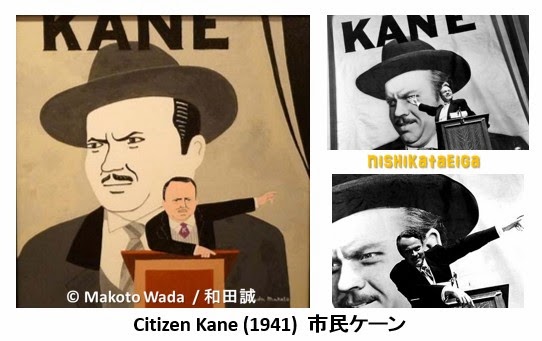
I was amused by how fat Orson Welles' head is in Wada's interpretation of this iconic image from Citizen Kane, because I didn't recall Welles looking so fat-headed in this scene.  But then I discovered that some stills of this scene do make his head extraordinarily large.... and of course Charles Foster Kane was indeed getting progressively big-headed throughout the film in the figurative sense. 


The Puerto Rican singer and actor José Ferrer is not as well-known today as many of his contemporaries (Bogart, Peck, Wayne, Tracy, Stewart), but he was a superstar in his time, winning the Tony in 1947 for playing Cyrano on Broadway before going on to win an Oscar and a Golden Globe for this screen portrayal.  Ferrer was the first Hispanic to win an Oscar.  To hear him in action, his best Cyrano speeches are available on iTunes.  He is arguably the top English Cyrano of the 20th century.  


For more by Wada: 

2015 Cathy Munroe Hotes

23 August 2014

Legend of the Forest, Part 2 (森の伝説 第二楽章, 2014)


At the inaugural biannual Hiroshima International Animation Festival in 1985, the legendary animator and manga-ka, Osamu Tezuka (手塚 治虫, 1928-89) won the Grand Prize with his experimental shot, Broken Down Film (おんぼろフィルム, 1985).  Thus it is fitting that his son, Macoto Tezka (aka Makoto Tezuka/手塚 眞, b. 1961) was able to complete Legend of the Forest, Part 2 (森の伝説 第二楽章/Mori no Densetsu, Daini Gakushō, 2014) in time for the 30th anniversary of the festival.  Tezka had announced his plans to make Part 2 at Hiroshima 2008, but many factors delayed production including the earthquake in 2011, and the fact that the animators were also involved in the production of Studio Ghilbi’s The Wind Rises (Hayao Miyazaki, 2013) and The Tale of Princess Kaguya (Isao Takahata, 2013), not to mention Evangelion: 3.0 You Can (Not) Redo (2012).  At the screening on the opening day of the festival, Tezka joked that just like his father, he is always missing deadlines.

Happily I can announce that the film was well worth the wait.  Before I review the new part, let me first summarize the background of the film: Legend of the Forest is an unfinished work by Osamu Tezuka (read my review).  Inspired in part by Disney’s Fantasia (1940), Legend of the Forest was intended to be a film in four parts, with each part corresponding to one of the four movements of Tchaikovsky’s Symphony No.4 in F minor, Op. 36 (1878).  Before his untimely passing in 1989, Tezuka had completed parts 1 and 4.  He left behind a synopsis and notes for Part 2, but no sketches.  Part 2 was to be made using classical Disney animation methods, such as those found in Pinocchio (1940) – which also screened at Hiroshima Thursday as a tribute to Ward Kimball who was International Honorary President at Hiroshima 1992 – and Bambi (1942). 


The soundtrack is the original recording of the Andantino movement of Symphony No.4 by the Tokyo Symphony Orchestra under Kenichiro Kobayashi which was used by Tezuka in the two works he completed.   With only the music and the notes by Tezuka as a guide, Tezka instructed the animators to make a film using traditional animation methods but in their own style.   The resulting film is very much a modern take on classical animation style. 

Just like the nature sequences in a Disney film of yesteryear, Legend of the Forest, Part 2 opens with a dramatic sweep into the forest.  Deeper and deeper, through layers of leaves the “camera” moves until we discover a female mayfly (カゲロウ/kagerō), trapped in a spider’s web.  A male mayfly spots the damsel in distress and flies to her rescue.  The drama that ensues, and the danger that they encounter as they float down an unpredictable river is beautifully rendered with an eye to detail. 

The mayflies have been anthropomorphized and resemble fairies, but the other creatures that they encounter have been drawn in a realistic fashion.  The character design is the work of former Mushi Pro animator Akio Sugino, famous for his collaborations with the late Osamu Dezaki, on board for character design.  The characters have sweet and very expressive faces without being too “kawaii”. 

The most impressive aspect of this animated short is the movement, not only of the characters, but also their environment (leaves, water, etc), and the movement of the “camera” through spaces.   It is pretty clear that the animators spent a lot of time listening to the music and imagining the sequences.   The film is truly a delight to watch and filled me with the kind of wonder I felt the first time I watched Fantasia.  The film is a wonderful homage to both Tezuka and classic Disney animation. 


At the screening, Macoto Tezka announced that he plans to also direct Part 3 himself.  According to the notes left by Tezuka, the animation for the scherzo should have no story, but be experimental in the style of Norman McLaren with puppets in the style of Jiří Trnka.  Tezka suggested that Part 3 would have a mixture of abstract and puppet animation and that the resulting film will be more in the style of Macoto Tezka himself than that of his father. 

There was no full credit sheet distributed at the festival, so I will add those details when they become available.   

The next opportunity to watch Legend of the Forest, Part 2, will be September 5-14, 2014 at the Brillia Short Shorts Theatre in Minato Mirai (Yokohama).

Official website: http://tezukaosamu.net/
Catherine Munroe Hotes 2014

http://hiroanim.org/