Hiroshima 2016 Focus on Japanese Animation:
Day 4
Sunday, August 21
8月21日(日)
Japanese Animation Special 15:
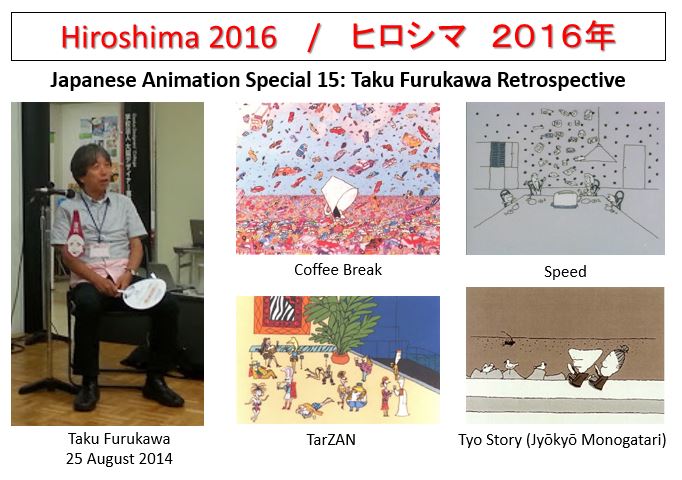
Taku Furukawa Retrospective (Screening and
Talk)

Taku
Furukawa is one of the Sōgetsu generation of animators who came to
prominence at the Sōgetsu Art Centre animation festivals of the 1960s and
1970s. Initially mentored by indie
animation pioneer Yōji Kuri,
Furukawa soon founded his own studio and developed an animation style all his
own. He has a caricature style that is
influenced by renowned New Yorker caricaturist Saul Steinberg, with a playful
approach to animation that is one of a kind.
In addition to being a member of ASIFA Japan, he is currently the president
of the JAA
(Japan Animation Association), which he took over after the passing of stop
motion master Kihachirō Kawamoto. In addition to his independently produced
works, Furukawa is famous for his numerous contributions to the long-running
NHK series Minna no Uta as well as
his commercial work. He is visiting
professor at Tokyo Polytechnic where he has mentored many students, including
two of my favourite animators – Hiroco
Ichinose and Tomoyoshi Joko, aka
Decovocal.
Earlier this year, Furukawa’s former students made a tribute to him
called Moving Colors (2016). Click on titles below to read reviews of
individual films by Furukawa.
2. Speed
(1980), Taku Furukawa
3. TarZAN (1990), Taku Furukawa
4. Tyo
Story (Jyōkyō Monogatari, 1999), Taku Furukawa
日本アニメーション大特集15:
古川 タク特集 (上映とトーク)
1. コーヒーブレイク 古川 タク
2 . スピード 古川 タク
3. ターザン 古川 タク
4. 上京物語 古川 タク
Japanese Animation Special 16:Contemporary Directors Collection ①
This
selection features a cross section of top contemporary Japanese animators with
established careers. Hyogo-born,
Kansai-raised Maya Yoneshō is based
in Germany and is famous for her mixed media approach to animation. Her work shows us that animation can be a
kind of international language and with her workshop students she has created a
series of Daumen Reisen (literally “Thumb Trips” – a term suggested to Yoneshō by an Austrian friend) – animated post cards against
city backdrops based on flip books (Daumenkino/"Thumb cinema" in German). Each of these short films is an hommage to the places where the workshops are taking place. The first such film she made by herself – Vienna Mix, or Wiener Wuast in the local, Viennese dialect.
Shin Hosokawa is a graduate of Tama Art
University (Tamabi) who specialises in stop motion animation. Hiroco
Ichinose and her husband Tomoyoshi
Joko (Joko is not included in this screening) are graduates of Tokyo Polytechnic University where
they were mentored by Taku Furukawa (see above). They currently work under the collective
title Decovocal making commercials and TV
programmes. Kaoru Maehara is a graduate of Kyushu Visual Arts College. Like
Hosokawa, Kanna Iida is also a
Tamabi grad but she specialises in drawn animation.

Reiko Yokosuka is a talented sumi-e (ink brush) artist who makes animation using her modern
take on traditional sumi-e style. Read her profile here
or check out her homepage. Kunio
Kato was the first Japanese person to win the Oscar for Best Animated Short
Film. A graduate of Tamabi he works for Robot Communications. Taruto
Fuyama is a graduate of Keio University and is known for the development of
his own stop motion animation software called Koma
Koma as well as his stop motion animation workshops. Frank,
an adapation of Jim Woodring’s cult
comic series Frank, is Fuyama’s best
known work. Kei Oyama studied animation at Tokyo Zokei and at the Image Forum
Institute of the Moving Image. He is
known for his unusual style of using scanned flesh for the textures in his
often surreal films. Hand Soap is his most acclaimed film to
date. Kei Takahashi has a BA in Oil Painting from Musashino and a
graduate degree in Video Art.
1. introspection (1998), Maya Yoneshō
2. Vienna Mix (Wiener Wuast, 2006), Maya Yoneshō
3. The Demon (2004), Shin Hosokawa
4. Ushi-Nichi (Cow's Day, 2008), Hiroco Ichinose
5. Tōsenbo (I Won't Let You Through, MV, 2009), Kaoru
Maehara
6. A Tender Soldier (2007), Kaoru Maehara
7. The Girl and the Crocodile (2006), Kanna Iida
11. Frank (2003), Taruto Fuyama
13. Child Trip (2006), Kei Takahashi
日本アニメーション大特集16:現代作家コレクション ①
1. introspection 米 正 万也
2. ウィーン・ミックス 米 正 万也
3. 鬼 細川 晋
4. ウシニチ 一瀬 皓コ
5. とおせんぼ 前原 薫
6. 優しい兵隊 前原 薫
7. 少女とワニ 飯田 甘奈
8. GAKI 琵琶法師 横須賀 令子
9. つみきのいえ 加藤 久仁 生
10. 情 景 加藤 久仁生
11. フランク 布山 タルト
12. HAND SOAP 大山 慶
13. こどものたび 高橋 慶
Japanese Animation Special 17:Contemporary Directors
Collection ②
This selection features more top
contemporary Japanese animators with established careers, as well as a couple
of lesser known names. Ayaka Nakata is a graduate of Tokyo
Zokei who makes independent animation and commercials. In addition to
animation, Yuki Sakitani is a
videographer and visual effects composite artist.
Atsushi Wada is one of Japan’s top
independent animators. He is a self
taught animator who refined his skills first at Image Forum, then in the first
class of Tokyo University of the Arts’s (Geidai) graduate programme in
animation. He has won many international
prizes for his work, most notably the Silver Bear at the Berlinale in
2012. Learn more about him in my review
of his CALF
DVD and in this 2010
interview. Wataru Uekusa is also a Geidai
grad, as is stop motion animator Mari
Miyazawa (Geidai 2014).
With her
minimalist aesthetic, Yoriko Mizushiri
has been a popular addition to international festival programmes in recent
years. Mizushiri studied at Joshibi
University of Art and Design. Tama Art
University (Tamabi) grad Yoko Kuno
has been wowing audiences both online and at festivals with her innovative
animated music videos for Cuushe.
Arisa Wakami dabbles in a wide variety
of animation techniques from sand animation to stop motion. Tamabi grad Mirai Mizue has also tried out a number of techniques but is mostly
famous for his “cell” animation style. Learn
more here. Daiki Aizawa is also a Tamabi grad.
Loop Pool was his graduate
work. He mostly makes digital content
for various clients – I am guessing he was included in this line up because he
is a member of ASIFA Japan, of which festival director Sayoko Kinoshita is also president. In preparing these blog posts I have noticed that most members of ASIFA Japan appear to have been included in the Hiroshima 2016 screenings.
I am not
familiar with the work of Takashi and
Motoko Tokuyama, but their 1992 work
Paralysis, which was shot on 16mm
screened at the 2015
PIA festival. They do not have a web
presence at all so it is a bit curious that they were included in this particular selection instead of one of the "history" sections.
Mai Tominaga (Tamabi) is a
multi-talented artist who has also directed some quirky feature films such as Wool 100% (ウール100%, 2006), Have a Nice
Day (ハヴァ、ナイスデー, 2006) and one of my faves Rinco’s Restaurant (食堂かたつむり,
2010). Her animation has featured on the
NHK and she has also directed commercials and live action TV drama.
Seiji Shiota is a freelance artist
based in Osaka. Tohru Patrick Awa is a character / concept designer who was born in
Santa Monica but raised in Tokyo and has been based in California since
2001. He has worked for Disney and
Warner Brothers (Learn more at Japan
Cinema). The Fly Band! is a short work Shiota and Awa made for Polygon
Pictures early in their careers. It won
the Prix Ars Electronica 1999.
1. Yonalure: Moment to Moment (2011), Ayaka
Nakata / Yuki Sakitani
3. The Tender March (2011), Wataru Uekusa
4. Futon (2012),
Yoriko Mizushiri
6. Airy Me (2013), Yoko Kuno
8. Blessing (2011), Arisa Wakami
10. Wonder (2014),
Mirai Mizue
11. Loop Pool (2004), Daiki Aizawa
12. Paralysis (1992), Takashi Tokuyama / Motoko
Tokuyama
13. Sirop de Namaquemono (2003), Mai Tominaga
14. Buonomo the Second Night (2002), Mai Tominaga
15. The Fly Band! (1999), Seiji Shiota / Tohru
Patrick Awa
日本アニメーション大特集17:現代作家コレクション ②
1. ヨナルレ M o m e n t to M o m e n t 中田 彩 郁 、サキタニ ユウキ
2. わからないブタ 和田 淳
3. やさしいマーチ 植草 航
4. 布団 水尻 自子
5. かまくら 水尻 自子
6. Airy Me 久野 遥子
7. デコレーションズ 宮澤 真理
8. Blessing 若見 ありさ
9. MODERN
No.2 水江 未来
10. WONDER 水江 未来
11. ル ーププール アイザワ ダイキ
12. パラリシス 德山 高志、德山 元子
13. ナマケモノシロップ 富永 まい
14. ボーノーモ第二夜 富永 まい
15. ザ・フライ・バンド Seiji Shiota、Tohru
Patrick Awa
Japanese Animation Special 18:Contemporary Directors Collection ③
Keita Onishi has an MA in Design from
Geidai. He is known for his video and
audio installation works. Koichiro Tsujikawa makes commercials
and music videos in addition to his independent work. He often mixes live action with
animation. Isao Nishigori is a visual artist who does music videos,
installations and other works pairing visuals with music. Atsushi Makino studied graphic design
in Prague before doing a graduate degree in animation at Geidai (2011). He works as an animation director for Eallin Japan.
I’m not sure
why Ko Nakajima is in this
selection. He should have been put into
a programme with experimental animators of his own generation (Nobuhiro Aihara,
Takashi Ito, et al.) – he began
experimenting with animation in the 1960s.
His work focuses on technological development and environmental
concerns.
The Higa
brothers (Kazutetsu and Yukinori Higa) are from Okinawa. They are known for their passion for special
effects (they are huge fans of Ray
Harryhausen and David W. Allen)
and puppet animation. Yūichi Itō and
Takuya Ishida are two of the top
stop motion animators working in Japan today.
Mainly known for his clay and puppet animation, Itō works with a variety
of media. In addition to his work for
the NHK and his independent works, Itō is a professor at Geidai. Ishida is known as an expert in clay
animation.
Acclaimed
3DCG animator Hiroyuki Okui is a
graduate of Musashino. I am not familiar
with Yoshiyuki Okada, his
co-director on Cave, and couldn't find any inforamtion about him online, but they jointly
won recognition for the film at Hiroshima 1994.
1. Dynamics of the Subway (2012), Haisuinonasa / Keita
Onishi
2. Cornelius / Fit Song (2006), Koichiro Tsujikawa
3. ACIDMAN short film "SAI (Part 1) /
Revolving...to the core" (MV, 2004), Isao Nishigori
4. Baloney Speaker (MV, 2004), Atsushi Makino
5. Seizōki (1964), Ko Nakajima
6. Kanahiru: The Iron Boy (2007), Kazutetsu Higa
/ Yukinori Higa
8. Knyacki Ep. 43 “Knyacki Pen” (1995), Yūichi Itō
9. How How Den Den (1987), Takuya Ishida
10. Minikoni Ep. “Chinese Zodiac Signs” (2003), Takuya
Ishida
11. Cave (1994), Hiroyuki Okui / Yoshiyuki Okada
12. Affordance (2002), Hiroyuki Okui
13. Fushigi Circus (2012), Hiroyuki Okui
日本アニメーション大特集18:現代作家コレクション ③
1. 地 下 鉄 の動 態 /ハイスイノナサ 大西 景太
2. CORNELIUS
「Fi t S o n g」 辻 川 幸一郎
3. ACIDMAN Shortfilm「彩 -S A
I -(前 編 ) / 廻る、廻る、その 核 へ」 西郡 勲
4. 戯 言スピーカー 牧 野 惇
5. 精造器 中嶋 興
6. 鉄 の子カナヒル 比 嘉 一哲、比 嘉 之 典
7. ハーバーテイル 伊藤 有壱
8. ニャッキペン 伊藤 有壱
9. はうはうでんでん 石田 卓也
10. ミニコニ十二 支 石田 卓也
11. ケイブ 奥 井 宏幸、岡田 義之
12. アフォーダンス 奥 井 宏幸
13. 不思議サーカス 奥 井 宏幸
Japanese Animation Special 19:Contemporary Directors Collection ④
This
selection of contemporary directors features a mixture of generations, all of
whom have become associated with certain styles of animation from CG to hand
made puppet animation.
Hiromi Habuto is Nara-based CG designer
and director. Saku Sakamoto is a Tamabi grad who is a freelance CG animator. I was someone who was slow to warm to CG
animation, but his 2002 work The
Fisherman made an
impression on me at my first Nippon Connection in 2008.
Yoshinao Satoh (or Satō) is a
Yokohama-based video game maker who makes terrific experimental animation. His film Newspaper
(watch here) was
popular with Nippon Connection spectators in 2015 where it screened in the Everything
is Visible programme. He is one of
my favourite artists at the moment.
Check out some of his works here.
Kotarō Satō is a University of Tsukuba
graduate who specializes in computer graphics design. In addition to his short animation works he
has taught animation at Tamabi and since 2009 at Kanto Gakuin. He has co-written two textbooks about computer
graphics and digital moving images.
Dino Satō began his artistic career
with the study of architecture, but retrained as a CG animator. His innovative works have screened widely at
international festivals. In addition to his
freelance animation work, Satō splits his time teaching at Musashino Art
University and Kyoto University of Art and Design
Nozomi Nagasaki was the first woman to
win the Noburō
Ōfuji Award for innovation in animation for her film Home Alone
(1996). She has her own studio where she
directs and animates stop motion using a variety of techniques including
puppets, clay, objects and cutouts. In
addition to her independent animation Nagasaki has made animation for
commercials, children’s television, movies, and video packages. She directed a film about stop motion
animation

Pecora’ped (ペコラペッド)
are a female animation team whom I met at
Hiroshima 2014. In addition to their
animation they hand make jewellery and other tie-in products using their unique
designs and characters. Saeko Akagi is a Musashino grad who
joined Robot Communications after graduation in 2005 as a commercial director. This year, she left the company to
concentrate on freelance storyboarding under the name Kibichu.
Yuta Sukegawa is a CG
animator. His work The Light can be viewed in full on his Vimeo page. Kiyoshi Nishimoto is a professor at
Musashino who specializes in Visual Communication Design. He has been a freelance animator since
1981.
1. Distortion (1998), Hiromi Habuto
2. The Fisherman (2002), Saku Sakamoto
3. Finder (2016), Yoshinao Satō
4. The Essence of War (2002), Kotarō Satō
5. Magnifying Glass (2006), Kotarō Satō
6. Let Out (2012), Kotarō Satō
7. Internal Peace and External Peace (2016), Kotarō
Satō
8. Treedom (1999), Dino Satō
9. Scrapland (2006), Dino Satō
10. Frog Seed (2010), Dino Satō
11. The Sexual Fish - The Fish that Forgot to
Breed (2014), Dino Satō
12. The Fourth of the Narcissus Month (1998), Nozomi
Nagasaki
13. SPONCHOI pispochoi (2010), Pecora’ped
14. Shimomomo (2003), Saeko Akagi
15. Apple Colored Water (2003), Saeko Akagi
16. The Light (2010), Yuta Sukegawa
17. Laminated Structure (1982), Kiyoshi Nishimoto
18. Laughing Moon (2000), Kiyoshi Nishimoto
日本アニメーション大特集19: 現代作家コレクション ④
1. ディストーション 羽太 広海
2. フィッシャーマン 坂元 サク
3. Finder 佐藤 義尚
4. 戦争の本質 佐藤 皇太郎
5. 虫眼鏡 佐藤 皇太郎
6. レット・アウト 佐藤 皇太郎
7. 内的平和と外的平和 佐藤 皇太郎
8. TREEDOM ダイノ サトウ
9. SCRAPLAND ダイノ サトウ
10. カエルのタネ ダイノ サトウ
11. 性的な魚‐繁 殖を忘れた魚 達 ダイノ サトウ
12. 水仙 月の四日 長崎 希
13. SPONCHOI
pispochoi pecoraped
14. しももも 赤木 沙英子
15. りんご色の水 赤木 沙英子
16. 灯花 助川 勇太
17. 積層体 西本 企良
18. 笑う月 西本 企良